PC GAMING: A HISTORY
PC gaming has come a long way. Christian Guyton looks at where it’s been and where it might go next
© BIG ANT STUDIOS, NACON, BIGBEN INTERACTIVE, WIKIMEDIA
IT’S FAIR TO SAY that when Connecticut-born physicist William Higinbotham started messing about with the trajectory-plotting features of the Donner Model 30 analog computer—a chunky block of metal covered in dials, designed for calculating the flight paths of ballistic missiles—he probably didn’t think he was birthing a medium that would eventually come to rival the film and music industries in terms of scale and worth. And yet, in 1958, at Brookhaven National Laboratory on Long Island, New York, that’s exactly what he did.
His initial prototype took only a few hours to design and less than a month to implement, using an oscilloscope display to render a simple “ball” and lines, along with a pair of custom-made controllers, each with a single button and dial. Two players took turns hitting the animated dot back and forth, using the dial to control the angle of each return shot.
Higinbotham—formerly a member of the team that developed the first atomic bomb, later a staunch advocate of nuclear nonproliferation—said that he thought his little game would “liven up the place,” and he was absolutely right. At Brookhaven’s annual public exhibition, hundreds of tech enthusiasts and highschoolers lined up to play Tennis for Two. The display was so successful that an improved version was put on show the following year, allowing players to simulate playing tennis in the low-gravity environments of the Moon and Jupiter. The machine was dismantled following the 1959 exhibition, its components required for less esoteric purposes.
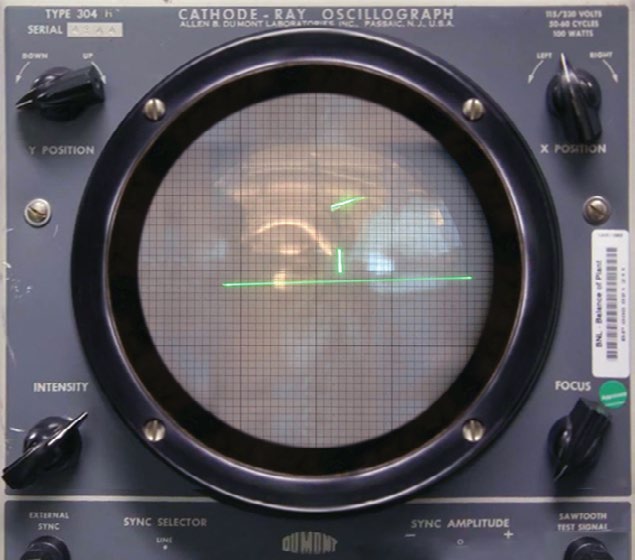
Tennis for Two on an oscilloscope and played with two custom aluminum controllers.
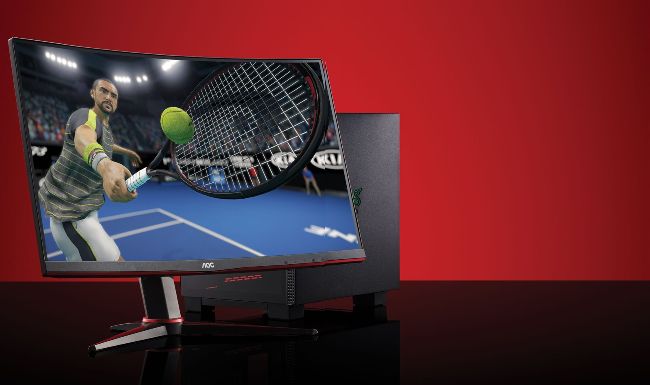
Fortunately, that wasn’t the end of it. More than 60 years on, high-schoolers still like pushing buttons to win at virtual sports, but the systems that power those digital matches have evolved beyond anything Higinbotham could have imagined. Last year, AO Tennis 2 was released, showcasing a fully modernized and breathtakingly detailed tennis experience, right down to the yellow fuzz on the ball and the sweat on Nadal’s brow.
The games and computer hardware industries have come a long way in those 60 years, slowly making their way from government-funded labs into our homes and pockets. So, just as Higinbotham charted the trajectory of his tiny “tennis ball,” we’re going to chart the momentous rise of the PC gaming industry.
TENNIS FOR TWO wasn’t exactly the first PC game to be created. For starters, the concept of a personal computer was alien at the time; multipurpose computers with real processing power were huge, while semiconductor technology was still in its infancy. Eight years before Higinbotham created his tiny tennis simulation, Canadian scientists produced Bertie the Brain, a 13-foot-tall behemoth capable of playing tic-tac-toe against a human opponent with varying levels of difficulty. Although Bertie was largely written off as a fun novelty at the time, adjustable difficulty levels remain relevant in games today, more than 70 years later.
There is some dispute as to what the first “PC game” is. Bertie was considered a “game playing machine,” but it lacked a proper display, simply using light bulbs and shaped cutouts of Xs and Os. Is this arguably a 3x3 resolution screen? That’s not for us to say. Tennis for Two cleverly utilized an oscilloscope as its display, but some argue that the first “true” PC game was Spacewar!,another two-player game designed by computer scientists at MIT for the DEC PDP-1 minicomputer in 1961.
If Tennis for Two was the precursor to Pong, Spacewar! was undoubtedly the inspiration for Asteroids. Players controlled two spaceships facing off against each other in the gravity well surrounding a star, everything presented in tiny dots, lines, and polygons on the PDP-1’s early CRT display. With limited fuel and missiles, the goal was to destroy your opponent’s ship, either with your own weapons or clever maneuvering to force a crash. While the first version was controlled with the PDP-1’s mess of tiny switches, programmer Bob Saunders created the first gamepads ever to exist, to better facilitate two-player games.
Spacewar! enjoyed cult popularity among the computing community in the ’60s, helped by the fact that its code was placed in the public domain. Other PDP-1 owners were able to play the game, and it was also ported to later models of the PDP. Some programmers using different computer systems even recreated their own versions. Spacewar! was even modified into Computer Space, the world’s first arcade game unit, ultimately spawning coin-op arcade gaming.