Intel’s
UNPACKING INTEL’S ROCKET LAKE AND BEYOND
After the Rocket come the Alders,Raptors,and Meteors
After gazing into broad wells, we’ve scoured the skies, poked at the kabies (whatever those are), drunk plenty of coffee—in two flavors—then returned to our celestial beginnings with comets. And then there were rockets. If that’s as clear as mud, we’re talking about the past seven generations of Intel desktop processors, all of which have one thing in common: They’re manufactured using a variant of Intel’s 14nm process technology.
Granted, today’s 11th-gen CPUs, aka Rocket Lake, have about as much in common with the 14nm lithography of Broadwell and Skylake as the latest SpaceX vehicles have in common with the space shuttle, but that’s a long time for a company that used to pride itself on alternating between new architectures and die shrinks every year. So, we’re peeling back the heat spreader and digging into the underlying architecture to find out what makes Rocket Lake tick. Or is it tock?
Intel isn’t done yet, either, and much as Broadwell for desktops was quickly kicked under the rug to make way for Skylake in 2015, there are promising future CPUs coming down the Intel pipeline. We’ll discuss what we know of Alder Lake and the upcoming 12th-gen CPUs, and even look at what lies ahead. So, latch your helmet, strap in, and let’s shoot for the moon.
–JARRED WALTON
BACKPORTING ROCKET LAKE
To understand Rocket Lake, we need to go back to Ice Lake, Intel’s 10th-gen mobile-only processors officially launched in late 2019. After an aborted launch of the first-generation 10nm Cannon Lake CPUs in 2018 (no, we don’t really count the Core i3-8121U), Intel went back to the drawing board to refine its already-two-yearsdelayed 10nm process. The result was a reasonably potent architecture, tied to a 10nm process that by all accounts struggled to reach the desired performance levels. Even today, with the server-focused Ice Lake SP launch having just happened, there were clearly some difficulties.
The best and brightest of the Ice Lake laptop chips reached a maximum CPU clock of 4.1GHz. That was the Core i7-1068NG7, a 28W part; the more common Core i7-1065G7 was a 15W configurable TPD chip that topped out at a less impressive 3.9GHz. Perhaps even more concerning, the mobile chips offered a maximum of four cores, with Hyper-Threading allowing eight threads. Back when Skylake was all the rage, that might have sufficed, but the attack of AMD’s Ryzen CPUs made such tame configurations look far less impressive.
While Intel reworked its existing 14nm desktop offerings to eventually reach eight-core and 10-core chips, it continued to struggle with Ice Lake and 10nm. Ultimately, the decision was made to backport the CPU architecture of Ice Lake to 14nm, which comes with all sorts of difficulties. The Sunny Cove CPU cores at the heart of Ice Lake were designed and built around a 10nm node; returning to 14nm would result in much larger chips, not to mention differences in the lithography rules between 10nm and 14nm. Despite the complexity, however, Intel made the decision to proceed.
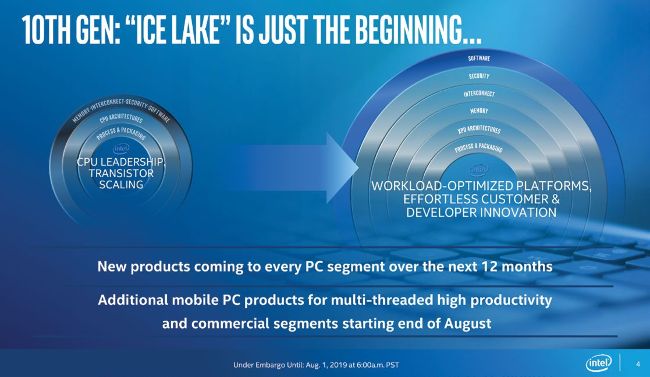
Ice Lake launched in 2019 and only offered mobile processors, but it is key to understanding the rationale behind Rocket Lake.
The result is the Cypress Cove CPU architecture. It takes many elements of Sunny Cove, then tunes things for 14nm, higher core counts, and higher clock speeds. Also, higher power. Outside of HEDT (high-end desktop) chips like the 18-core i9-7980XE, Rocket Lake is one of the most power-hungry chips Intel has ever created.