THE NEWS
Rocket Lake Lands
Intel’s desktop chips finally get a new core
IT FEELS as though we’ve been waiting an age for this. Intel has finally released a desktop CPU with a new microarchitecture: Rocket Lake. It carries a Cypress Cove core, a derivation of Sunny Cove, which was first unveiled in 2018. Originally destined to be a 10nm design, due to myriad technical reasons, Intel had to change tack and “back port” the design to 14nm. So, what we have is the CPU from an Ice Lake chip, combined with Tiger Lake’s GPU, all rejigged on to a 14nm die. It’s a clumsy compromise. AMD smoothly moved to 7nm nearly two years ago. Officially, the new arrivals are 11th Generation S-Series processors.
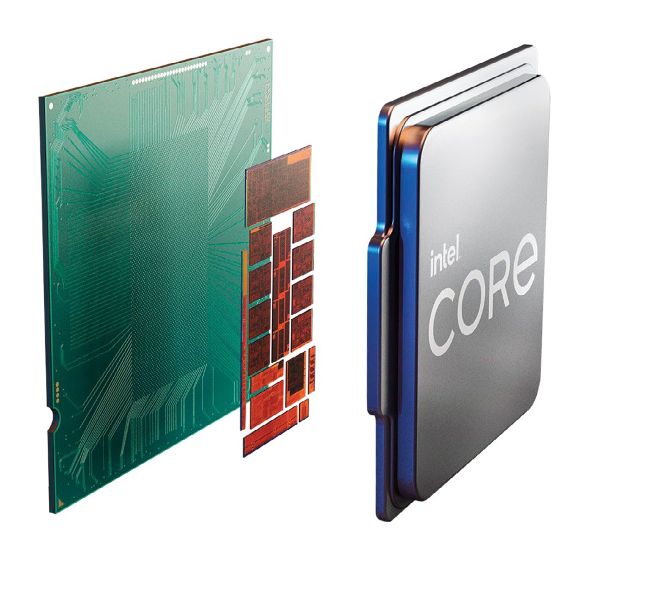
14nm lives on—it’s not what Intel planned, but at least we get a version of Sunny Cove on the desktop.
© INTEL
Whenever a new CPU microarchitecture arrives, the first question is: What is the IPC (Instructions Per Clock) improvement? Intel claims it is 1.19. This is reasonable, and comparable to the steps AMD’s Zen design has made. The next question is: How many cores? This is one of AMD’s strong suits, of course. All the new Core i9 and i7 chips have eight cores, while the Core i5 range has six. Intel reckons the IPC lift should compensate for the lower core count in the Core i9s, while it should give a reasonable bump for the Core i7 and i5 chips, where the core count is the same. AMD’s 16-core beast is $260 on top of Intel’s best, but the 12-core Ryzen 9 5900X is only $10 extra for four more cores. Luckily for Intel, game performance currently tends to stutter after you reach eight cores, but for content creation, it’s a real advantage. Why stop at eight cores? Apparently Intel ran out of space on the die, if this is to be believed.
There are 20 or so new versions, all middle and high-end models. Core i3, Pentium, and Celeron brands are being refreshed, with slightly higher clock rates, but no Cypress Cove cores or other goodies. At the top of the tree is the Core i9-11900K, with a base clock of 3.5GHz, an all-core boost of 4.8GHz, and a maximum single-core boost of 5.3GHz given perfect conditions. Intel has a confusing number of “boost” technologies; it lists four variations for the i9-11900 chips in the promotional material. These include a new Adaptive Boost Technology, which can dynamically boost speeds given enough thermal headroom. There has been little real movement in clock rates, bar a modest 100Hz here and there, so this is one area where Intel does score—sometimes there is no substitute for raw clock speed.