VIRTUAL REALITY IN 2021
How close to a different reality can virtual reality really take us?
Sam Lewis
OVER THE COURSE of the past seven decades, the term “virtual reality” has been thrown around quite a bit within the tech world. However, during that time, it has actually become a rather divisive and subjective form of entertainment. Tedious and awkward are just two ways it has been described. The term itself most certainly encompasses far more now than when the modern take on the technology first debuted in 2016. Heck, today you can get VR headsets for your phone that cost just 10 bucks, while on the flipside you could easily spend over $1,000 getting all the right gear for the ultimate virtual-reality rig.
What VR has been missing since its conception, however, is simplicity and efficiency, and that is seemingly finally starting to change, with better-supported tech and easier-to-use setups.
The bottom line is that there have been many attempts at VR, which have just not taken off and hit the mainstream market in the same way as gaming PCs and consoles have. They aren’t as accessible and affordable, and with many setups, you need a powerful PC to run them properly. Space is a massive factor, too, as you need a comfortable area to use it, and this can be a problem for many.
This month, we’re taking a look at VR as a whole—where it has come from, some of the latest advances, and the trajectory that this sector of technology is heading in. Will VR headsets finally replace the trusty old monitor? Or is there room for both in the future world we’re building?
VR Development
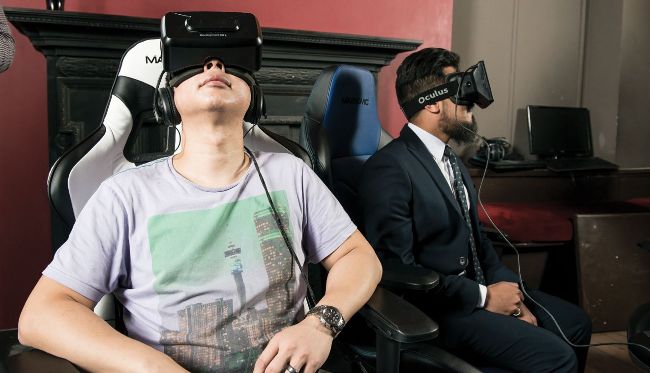
One of the early development kits for the Oculus Rift— business suit not included.
THE NOTION of virtual reality has been used in the tech sector over the last seven decades, but the rate of progress has been slow. Its aim is admirable and enticing: To take you into a fully realized alternate dimension, where you can take a step away from your day-to-day life and become fully immersed in whatever game or media you’d like. When you think about virtual reality, you immediately think of a VR headset/goggles; this concept has been around for years and has stuck true to its original designs in a way.
One of the goals for the technology is that the user should feel as though they are in a different world. This concept could be seen back in the 1950s, with the invention of the Sensorama. Cinematographer Morton Heilig conceived the idea in his 1955 paper “The Cinema of the Future.” His design was a machine where the user sat inside a box and watched a movie. This heightened all the user’s senses because they were entirely enclosed. By 1962, he had a working prototype that was able to show wide-angle stereoscopic 3D video. Other features included stereo sound, wind, vibrations, and even aromas. The prototype launched with five short films to preview, one of which was a motorcycle ride through New York City. This idea of being able to virtually travel and experience different lifestyles is still partly what fuels the use of virtual reality to this day. Thankfully, The Walking Dead wasn’t around in the ’60s; we can’t begin to imagine what aroma they would have used for that.
Skip forward to 1965, and the form factor we see today was starting to take shape. A scientist called Ivan Sutherland started the idea of what we call virtual reality. In his essay titled “The Ultimate Display,” he described a computer with a connected display that gave users the chance to gain familiarity with concepts not realizable in the physical world, “a looking glass into a mathematical wonderland.” Scientific, we know, but the concept of a “virtual reality” was there.
Moving on to 1968, Sutherland and some of his students created the world’s first head-mounted display. Pretty impressive for the time, right? The system was made of two CRT monitors with mirrors and prisms inside. This allowed for digital wireframe graphics to be superimposed over what you could see. The device had six degrees of tracking, with three ultrasonic transmitters on the headset, picked up by four receivers hung from a ceiling. You get the sense that this wasn’t a small device by any means. Sutherland named his invention the Sword of Damocles. Unfortunately, it didn’t see much progression, probably due to its expense and impracticality.