ARMing the World
Apple is dumping Intel processors for its own ARM-based designs. Will the traditional PC be next?

Fugaku: We don’t even know what you’d do with 415 petaflops, but apparently it runs Linux.
© GETTY IMAGES
NO ONE WOULD HAVE BELIEVED in the last years of the 20th century that the processor world was being watched keenly and closely by intelligences greater than Intel’s. Yet across the gulf of the Atlantic in a country called the UK, intellects vast and cool regarded the processor market with envious eyes, slowly and surely drawing their plans against Intel…
Apple is dumping Intel processors for its own design of silicon. How did this happen, and what, if any, are the ramifications to the wider PC market? How can a processor design that started life in an obscure, failed British home computer of the 1980s now challenge the entire Intel empire? We’re going to delve into the ARM microarchitecture, have a look at how it’s advanced over the years, how those architectural advances have borne out in benchmarks, and contrast the results to those of Intel desktop parts.
As we do this we’re going to find two contrasting stories: One of maximizing performance increases generation by generation, and the other offering fixed incremental increases from generation to generation. We can delve behind the reasoning for why those increases played out like they did, and we can argue if ultimately those have been good decisions or not.
We can also argue about competition in the marketplace and ultimately how that’s good for us, the consumer. But an architecture running an entirely different instruction set-is that good for PC consumers? Perhaps we’re getting ahead of ourselves.
NEIL MOHR
WHAT IS AN INTEL PROCESSOR? What is a PC? If you hark back to Maximum PC’s December issue in 2019, John Knight wrote about the history of the PC as a standard. When IBM was part-picking, it could have gone with its own IBM 801 RISC processor, but the budget insisted on the Intel 8088, and history was set: Every compatible PC would be running an x86-compatible processor.
Technically anyone “could” design and manufacture an x86-compatible processor, but legally Intel owns the patents to the instruction set and has to license it for that to happen. If a company has ever produced a design or manufactured an x86 processor, it’s because Intel (or a court) allowed it to. AMD is different, as it has a complete cross-patent licensing agreement with Intel, so the two companies don’t end up suing each other into oblivion.
Over the years there has been a choice of different x86 manufacturers: IBM made a range of 386/486 processors, AMD, Cytrix, VIA, NEC, Transmeta, and some others, with the running theme usually being low-end designs. Intel has always been the x86 top dog, with the others (apart from AMD and the IBM days) being also-rans. So you could argue there has been competition in the market, if fighting over the dregs counts as competition.
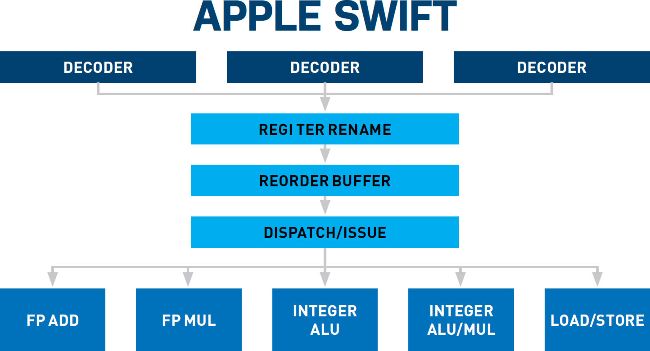
The 2012 Apple-designed Swift core was a huge step forward.