BLOOD BROTHERS?
In 1969, a founder member and the ’60s, notoriously, lost its innocence. But as the band’s reputation grew darker, and the bonds between them were tested by infidelity and ambition, their music hit new heights of soulful power – sped by the recruitment of a next-level guitarist, and encapsulated on THE ROLLING STONES lost Let It Bleed. “That was the period when the player was as big as the song,” discovers by MARK PAY TRESS.
Portrait RON RAFFAELLI.
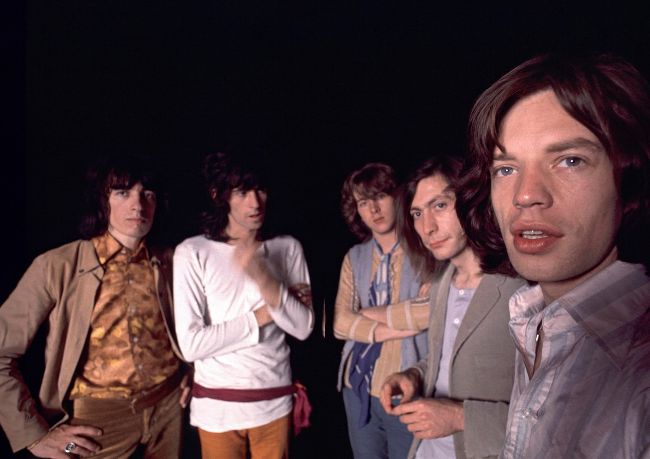
A deeper cut: The Rolling Stones at their first photo shoot with new guitarist Mick Taylor, June 12, 1969 (from left) Bill Wyman, Keith Richards, Taylor, Charlie Watts, Mick Jagger.
Ron Raffaelli
ASK BILL WYMAN TODAY WHETHER BRIAN JONES “HAD TO GO” and the deadpan Stones bassist trots out a familiar line: “Brian was the brilliant guitarist and instrumentalist who created The Rolling Stones but destroyed himself with drugs and alcohol.”
Anna Wohlin, Jones’s live-in Swedish girlfriend from late spring 1969, painted a rather different picture when I spoke to her in 2008.
“Brian was so happy with his country life,” she recalled. “He loved that house, he loved the area, he loved his garden, every fruit, every vegetable. He liked the quiet and ordinary people. He wanted to stay there for at least another year just to calm down. He’d had enough of the madness.”
There’s one thing missing in Wohlin’s version of life at Cotchford Farm, where A.A. Milne wrote his Winnie-the-Pooh books. It’s that Brian Jones’s immersion in “the madness” had been so complete that his dismissal from the group in June 1969 had become inevitable.
Jones had been the first Stone to drop acid, the first to experiment with electronic music and the first major British pop star to proclaim pop’s role in the imminent youth revolution. “Young people are measuring opinion with new yardsticks, and it must mean greater individual freedom of expression,” he said in October 1966. “Pop music will have its part to play in all of this.”
By late 1969, youth issues were at the forefront of Western society. Brian Jones was dead, but what The Rolling Stones did and said was now of far more consequence. Their next album would be the most high-stakes of their career thus far.
IN DECEMBER 1967, AFTER A YEAR spent battling the establishment in court over a series of drug busts, the Stones emerged with Their Satanic Majesties Request, a good trip/bad trip sonic equivalent to Bosch’s The Garden Of Earthly Delights, or The Beatles’ Sgt. Pepper re-imagined as a hellscape. Jones was in his element, playing mellotron on several tracks, electric dulcimer, recorder and anything else that passed through his gifted hands. “I thought it sounded like Turkish music when they played some tapes to me that summer,” says Stash, alias Stones insider Prince Stanislas Klossowski de Rola.
Keith Richards, whose major contribution had been the riff-led Citadel, wasn’t convinced. Once the disorganised sessions were over, he decided to revisit his vast collection of blues records. “People would say, ‘What you playin’ that old shit for?’” he told Robert Greenfield in 1971. “[That] really screwed me up ’cos that’s all I can play.”
Back in 1966, Richards was still being described as “the ignored Stone”, famed for his pimples and jug ears. “He was a very vulnerable figure,” says Stash, who remembers a heartbroken Richards taking refuge in Jones’s busy Courtfield Road flat later that year. “He was so bluesy after being dumped by Linda Keith.”
The group dynamics began to change once Anita Pallenberg, bored by Jones’s tantrums, seduced Richards during a trip through Spain towards Tangier in March 1967. “Keith was conservative,” says Stash. “He would never have made the first move.” But Pallenberg’s powerful presence – fiercely intelligent and beautiful – coincided with the flowering, during the next two years, of Richards from inconspicuous youth to poster boy for rock rebellion.
Meanwhile, Mick Jagger had cemented his role as pop’s leading spokesman during the Stones’ 1967 drug trials and as the group’s helmsman after the departure of whizz-kid manager Andrew Loog Oldham. Jagger’s first initiative was to set up the Stones’ personal office, run by Jo Bergman – “very much Mick’s person,” New Musical Express journalist and Stones’ intimate Keith Altham told me.
Quietly, the Stones were starting to move in different circles. In May 1968 it was announced that Jagger had bought a house at 48 Cheyne Walk in Chelsea and a country estate, Stargroves, in Hampshire. He’d also signed up to appear in a forthcoming film, The Performers, soon to be retitled Performance, with Pallenberg cast as a love interest. Meanwhile, Jagger’s real-life girlfriend, actor and singer Marianne Faithfull, was furnishing their Chelsea home with chandeliers, a Louis XV bath and a four-poster Regency bed.
The pair attended parties hosted by Dirk Bogarde and had already coupled up with Jagger’s movie costar James Fox and his partner Andee Cohen, with whom they’d discuss fashionable topics such as reincarnation. When alone, Faithfull would read up on fairies or Alice Bailey’s A Treatise On White Magic, while Jagger digested Malory’s Le Morte d’Arthur or his volumes of Penguin Modern Poets.