THE MOJO INTERVIEW
Homophobia, self-hate and obscurity were his foes until Queen Of Denmark raised him up. A fêted oeuvre of psychic unburdening has since flowered, but success has proved no panacea: “It’s a very distorted view of reality,” saysJohn Grant.
Interview by VICTORIA SEGAL
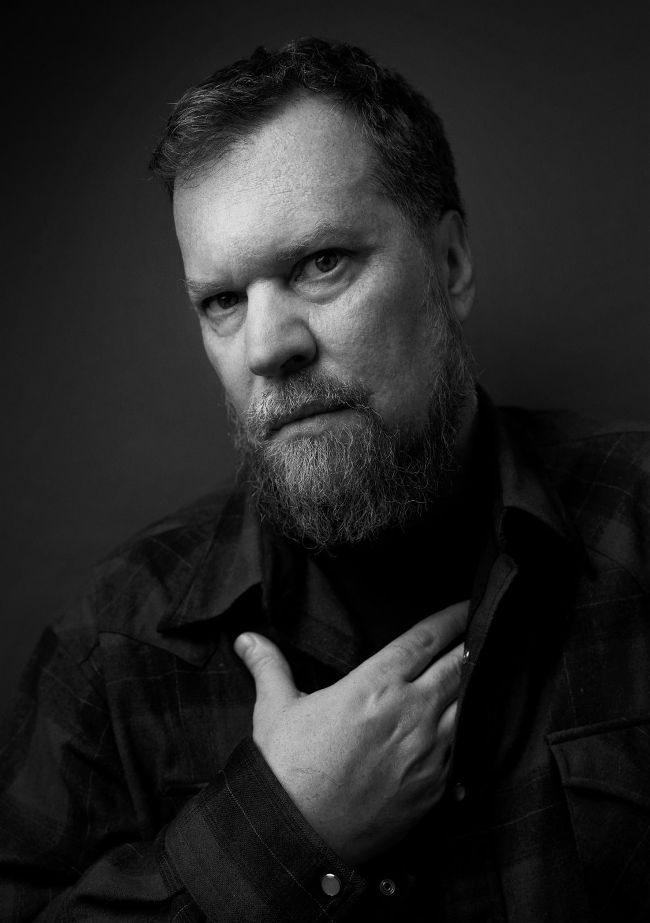
• Portrait by TOM OLDHAM
“LOOK UP BARN OWLS ON YOUR phone!” insists John Grant as he flicks through The Illustrated Lyrics, a handsome new book that sets words from the Michigan-born singer-songwriter’s six solo albums alongside photographs he’s taken. He’s poring over a shot of his crumpled bedsheets which have folded themselves into a remarkable semblance of the bird – think the Turin Shroud, only avian – and is keen to convince MOJO of its similarity to the real thing. Grant likes finding patterns, he says, but he’s loath to call himself a photographer. “I just do it with my phone – that’s why I say I ‘fancy myself as a photographer,’” he says with Victorian delicacy, “because I don’t really know how to deal with a camera.”
Such imposter syndrome is a recurrent theme in Grant’s conversation – even today, when he is clearly at the centre of his universe, emerging from a rehearsal studio in Putney where he and his band are putting in nine-hour days ahead of his tour. The mood is focused and slightly tense, the musicians eager to return to work, but Grant amiably surrenders his lunch break to an interview, with the polite proviso that his colleagues bring him a tuna melt.
This year, Grant released The Art Of The Lie, a record that further probes the faultlines between the personal and the political, family and ideology, love and harm, and ranks high among MOJO’s Albums Of 2024. Born in 1968, Grant grew up gay in a Christian family where his hidden sexuality was a source of corrosive shame. Inspired by Neue Deutsche Welle star Nina Hagen’s 1982 album NunSexMonkRock – “It changed me forever” – in 1988 he escaped to Germany to study German and Russian. After six years, he returned to America, co-founding Denver alt-rock band The Czars in 1994.
Working through a period where Grant’s anxiety escalated alongside his drug and alcohol abuse, The Czars splintered in 2006. In the aftermath, Grant headed to New York. Estranged from music as he worked as a waiter, hospital interpreter and flight attendant, it took Texan band Midlake to take him under their wing and help him make his solo debut, 2010’s Queen Of Denmark. Metabolising raw trauma into burnished ’70s soft rock, it gave Grant his breakthrough at 42. Sinéad O’Connor, an artist who knew something about pain, was listening: she covered the title track and sang on Grant’s 2013 album, Pale Green Ghosts. On it, the song Ernest Borgnine touched on Grant’s HIV diagnosis, information he announced on-stage at the 2012 Meltdown Festival.
Grant counts Elton John a friend and has collaborated with artists including Tracey Thorn, Kylie Minogue and – in Creep Show – Cabaret Voltaire’s Stephen Mallinder. Linda Thompson loves him so much she wrote a song about John Grant, called John Grant, for Grant to sing, on her album Proxy Music. But embracing acceptance, he says, has been “a process”.
Settling on the studio sofa surrounded by vocoders and setlists, Grant notes his tendency to tackle that process head on, both in his music and media outings, wondering, “Does anybody else talk to you this way when you do an interview?”
When did you first start thinking of yourself as a songwriter?
I just remember with The Czars being really intimidated because of all those who had come before me. I knew I had something to say but I was really scared of my own shadow and really unsure of how to do it. I looked at people like Rufus Wainwright who was fully formed out of the box, right from the start with his first record, and it really took me a long time to get my bearings.