HOW TO BUY
Charles Mingus
The great jazz bassist and anarchic genius.
By Andrew Male.
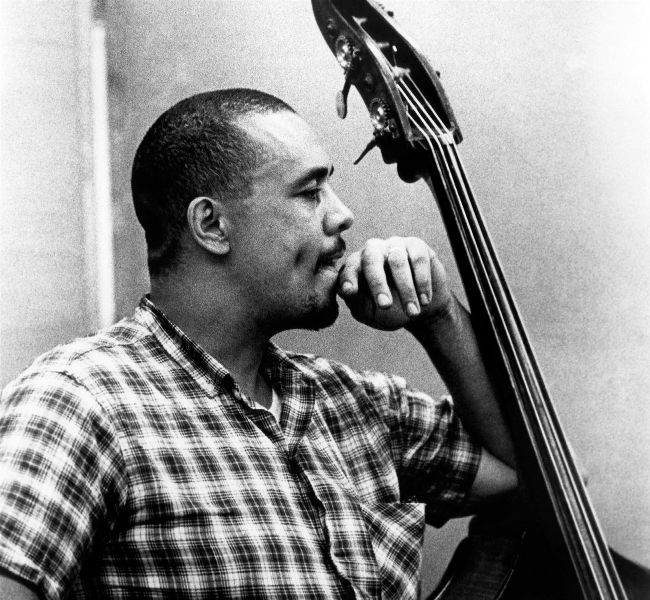
Double trouble: late-’50s vintage Charles Mingus.
Glasshouse Images/Alamy, Michael Ochs Archives/Getty Images
BETWEEN FEBRUARY and November of 1959 the Arizona-born jazz bassist and composer Charles Mingus recorded three long-playing masterpieces that belong in the collection of any true jazz aficionado. They are Mingus Ah Um, Blues & Roots and Mingus Dynasty. The fact that only two of these records have made it into this list of 10 albums might give you some idea of what we are dealing with here.
As he writes himself in his incendiary and often unreliable 1971 memoir, Beneath The Underdog, Charles Mingus was born in 1922 to “the daughter of an English/Chinese man and a South American woman [and the son] of a black farm worker and a Swedish woman.” His light skin, his two biracial parents, and his poor education were a constant source of discomfort for Mingus, one that instilled in him a complex volatility and combative defiance, combined with a constant need for both self-improvement and affirmation of identity that you hear throughout his career.
Taught double bass by LA session musician Red Callender, and New York Philharmonic Orchestra’s Herman Rheinshagen, Mingus toured with Louis Armstrong and Kid Ory in the ’40s, quickly establishing his name as a bass prodigy, master improviser, expert time-keeper and inventive melodicist. Throughout the early 1950s he played with such heroes as Duke Ellington, Charlie Parker and Bud Powell; his appearance on the famous May 15, 1953 concert at Toronto’s Massey Hall alongside Parker, Powell, Dizzy Gillespie and Max Roach is another LP that would make the How To Buy list if we weren’t dealing with such a prolific genius.
“He was pushing the boundaries of improvised and free music.”
Mingus also studied Schoenberg, Stravinsky and Bartók, and in 1955 formed a co-operative composers’ workshop with saxophonists Jackie McLean, Eric Dolphy and Rahsaan Roland Kirk, seeking new ways to collaborate and compose without notation that would incorporate influences from blues, gospel, popular song and modern classical music. At the same time, he was pushing the boundaries of improvised and free music. With the support of his constant companion, the drummer Danny Richmond, he changed the Basie and Ellington big band blueprints into something that could accommodate the wild, raucous and immediate, alongside the sophisticated, melodic, and intelligent. However, if Mingus’ 1950s and early ’60s were a time of revolution and reinvention, his late ’60s were a period of exhaustion, beset by financial and mental health problems. A comeback came in the early 1970s, first with Beneath The Underdog and then the release of Let My Children Hear Music, but the effects of motor neuron disease gradually sapped his strength until his death on January 5, 1979, aged 56. As a result, there can be no real historical overview here, just an attempt to pick out 10 studio albums that define the multi-faceted, anarchic genius of Charlie Mingus.