LOVE HURTS
Divine, deranged, divided: it’s taken 50 years and change for LOVE’s JOHNNY ECHOLS to make peace with his doomed band’s ageless legacy. In 2023. the Book of Love is reopening, but not before the guitarist confronts its more contentious passages.”1 won’t sugar-coat it.” he tells ANDREW PERRY. “There’s nothing to hide."
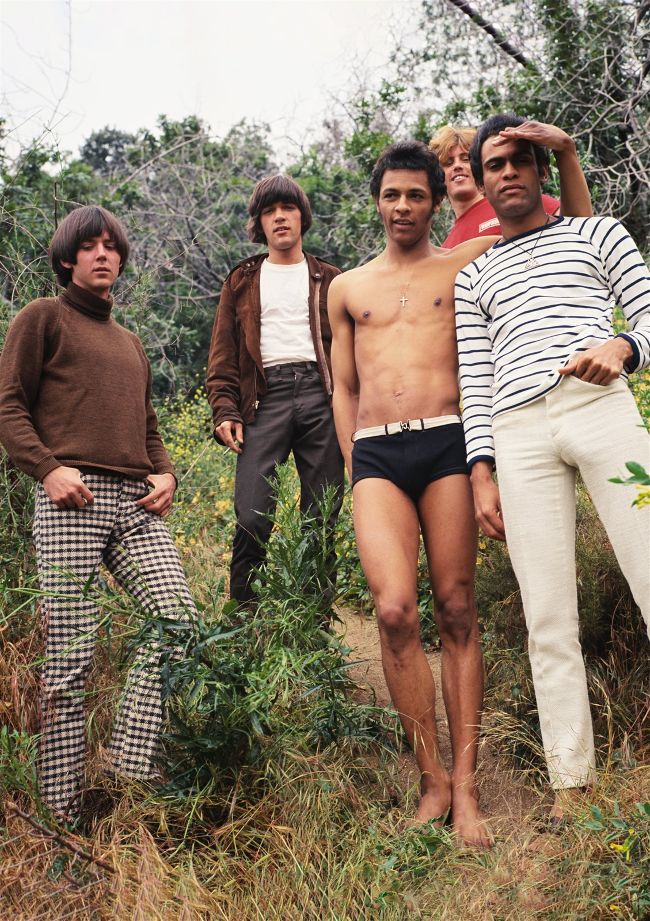
Nature boys: Love in Los Angeles, July 1967 (from left) Michael Stuart-Mare, Ken Forssi, Arthur Lee, Bryan MacLean and Johnny Echols.
Getty
SCHOOLMATES AT SUSAN Miller Dorsey High School in West Los Angeles, Arthur Lee and Johnny Echols were thick as thieves, with everything in common bar one: Johnny Echols lived to make music; Arthur Lee could barely play a note. “Then Arthur saw our band playing at an assembly, and all the attention we were getting from the girls,” Echols remembers, “and he asked if he could join. We started him on congas. Later on, we noticed that Arthur had a real rapport with the audience. Even though he wasn’t a musician per se, he’d get up and entertain people. Then we found out he could sing, and he became our vocalist, more and more out front.”
Echols pauses: “Arthur has a personality where he takes over things, whereas mine is more passive. I prefer being in the background.”
The dynamic cast a long shadow over the band Echols and Lee would eventually christen Love, and its legacy. At the group’s mid-’60s peak, in a striped hipster suit and brandishing a double-necked electric guitar, Echols cut a super-cool figure. But the legend of the band’s ascent and culmination in 1967 masterpiece Forever Changes has always been dominated by Lee.
The making of Forever Changes tore the band apart, scuppering its success but for cult acclaim. The inner fracture is often attributed to Lee’s battle for supremacy with Bryan MacLean, the bumptious uptown folk rocker who wanted more of his own compositions included. Echols, now 75, has outlived both to curate Love’s catalogue and renewed activities – including an upcoming UK tour – and he’s keen to supplant that binary portrayal with a more collective narrative.
“For years, I didn’t talk,” he admits from his home in the hills overlooking LA, “but now I’d like my family to know the truth, and to give people the facts. I won’t sugarcoat it. There’s nothing to hide.”
Love snatched defeat from the jaws of victory not once – in 1967 – but twice. In the early ’00s, after Echols joined Lee and his long-serving Love band, AKA Baby Lemonade, for victory laps performing Forever Changes in all its orchestral majesty, Lee contracted acute myeloid leukaemia and in 2006 he passed away.
Along their troubled path, there has been betrayal and bitterness, addiction and imprisonment, but also redemption. While Lee was one of the most problematic characters in rock history, it’s telling that both Echols and Baby Lemonade guitarist Mike Randle still talk of him in the present tense, with an air of wonder and affection. As Randle confides, “I don’t see Arthur as being gone, man – he’s everywhere!”
Echols, meanwhile, repeatedly flags up the serendipity which brought Love together and allowed them to sculpt three wonderful records rightly adored across six decades. But no, he won’t sugar-coat it.
“We fought tooth and nail,” he says, of their shared dream. “We wanted it, but we did everything we could to destroy it.”