PLAYING CATCH-UP
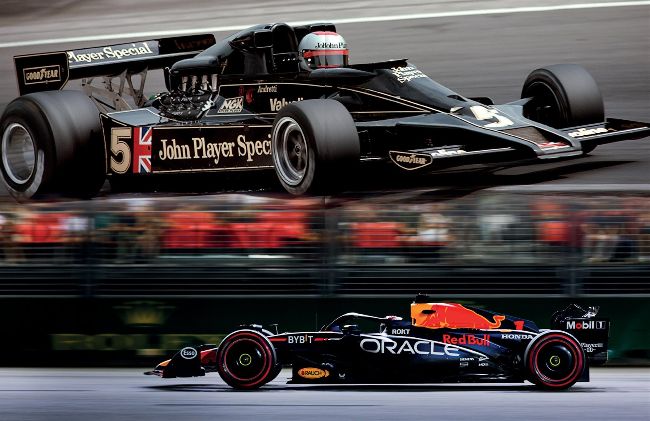
In 1977, Lotus stole a march on its Formula 1 rivals with its ground effect design. As Mark Hughes sets out, there are clear parallels between Colin Chapman’s foresight and what is happening at Red Bull today
BERNARD CAHIER/GETTY IMAGES, DPPI
Colin Chapman was very irritated. He was a day late arriving at the 1977 Belgian Grand Prix and during Friday qualifying, in Chapman’s absence, Mario Andretti had lapped 1.54sec faster than anyone else. Chapman took Andretti to task for revealing the extent of the car’s advantage. Everyone would be wanting to find out the secret of the Lotus 78 now, he scolded.
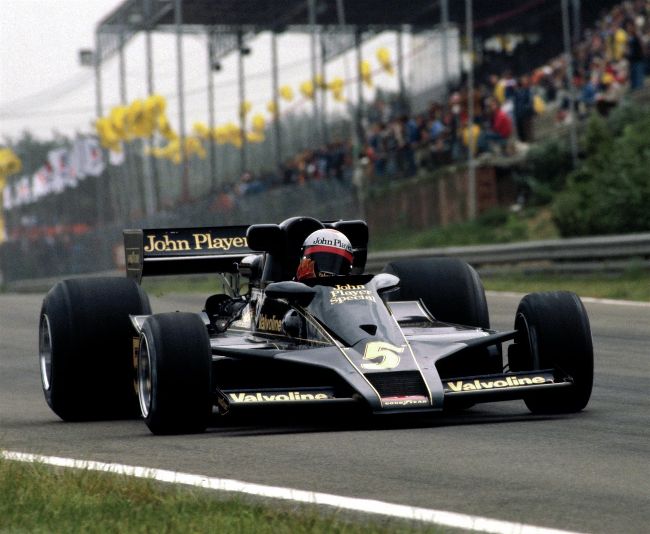
Mario Andretti set a blistering pace at Zolder in 1977 in the Lotus 78, but Colin Chapman was far from happy
Its secret, of course, was ground effect – a secret that could only be implied by the Lotus’s unusual shape but which would have required a good look at its internals to understand. So it was a secret that took a while to be decoded. In the right circumstances, such as those of Zolder where Andretti set that resounding pole, the 78 was in a different league to its 1977 rivals. The next big technological leap in F1’s evolution had just been taken. As such, a grid-full of copies may have been expected for 1978. Yet it didn’t happen like that. Tony Southgate – who had been part of the Lotus 78 programme – created the ground effect Shadow DN9 and Arrows FA1 (the same design for two different teams). Harvey Postlethwaite gave us the distinctive radiatoron-the-cockpit-front Wolf WR5. And that was it. They were the only two ground effect designs competing with the title-winning Lotus 79 in 1978. No other team had gone near ground effect despite its obviously enormous potential and despite watching the Lotus’s performances through ’77.
Ferrari and Brabham were thwarted anyway by the unsuitable shape of their flat-12 engines, but even so Ferrari’s Mauro Forghieri said at the time that he was unconvinced that ground effect was even real! Brabham’s design chief Gordon Murray recalled: “No one knew exactly what they’d harnessed. We were all still trying to understand it.” Others – including Williams’ Patrick Head – said they wished to get a fuller understanding of it before committing to such a design (which a couple of years later would materialise as the FW07). It wasn’t until 1979, two years after Lotus had shown the way, that we saw a grid full of ground effect cars.