A loisa Ruf
The youngest member of Pfaffenhausen’s first family of high performance is marrying her artistic talent with her restoration skills – and has exciting plans for Ruf ’s future
Words Elliott Hughes
HAGOP
Photography Ruf
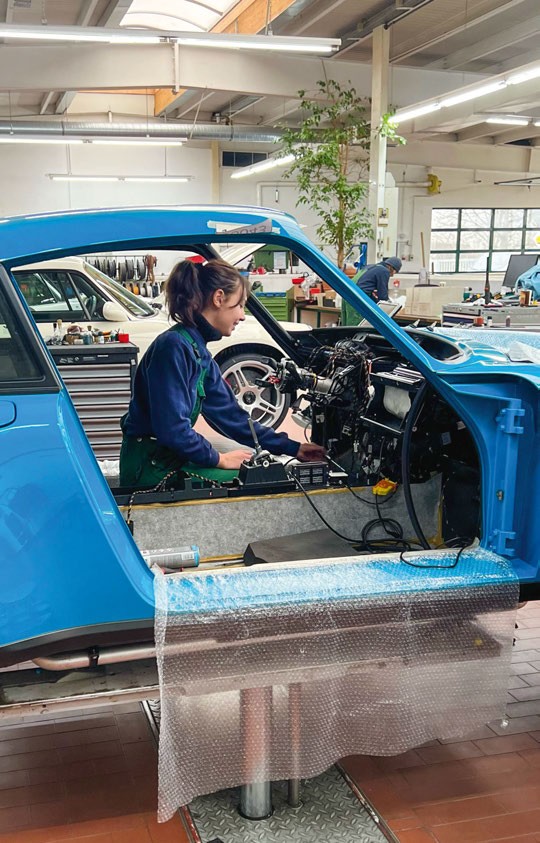
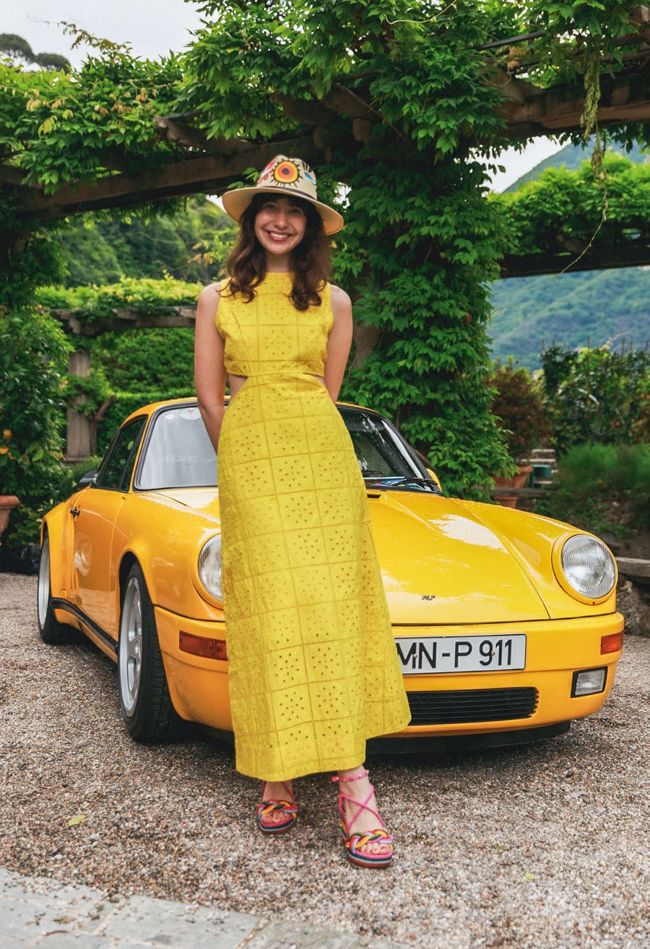
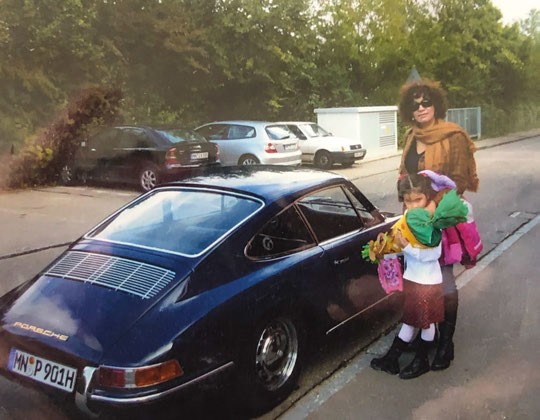
Clockwise, from opposite Aloisa with the Yellowbird at Villa d’Este, the first time a Ruf has participated in a concours; with her mother on the first day of school in the Bali Blue 901; working on the CTR production line.
R-U-F. IN THE world of Porsche, these three letters are legendary. But they are also the surname of Aloisa Ruf, the latest generation of a family that transformed a small garage in Pfaffenhausen, Bavaria, into a globally renowned performance marque. Now, she is writing her own chapter of the family’s storied legacy.
‘The factory has always felt like a second home,’ says Aloisa, smiling over a video call. Warm, friendly and articulate, the 23-year-old has an innate passion for cars that is immediately obvious – perhaps unsurprisingly, given her surname. ‘When I was a kid, I was basically the company mascot without even knowing it. I was friends with all the suppliers and customers.’
For any petrolhead, the idea of growing up at Pfaffenhausen is intoxicating, and for good reason. The company was founded in 1939 by Alois Ruf Sr as a service garage that became a petrol station in 1949. By this point, Ruf Sr had broadened his horizons into vehicle design and created a tour bus in 1955 that developed into an offshoot company. Alois Sr passed away in 1974 and the company was taken over by his son, Alois Jr, whose passion for sports cars – and Porsches in particular – inspired him to create upgrade packages for 911s. The first Ruf-enhanced 911 arrived in 1975 and by 1977 the company was producing its first standalone model: a Porsche 930 Turbo powered by a 3.3-litre flat-six.