Review
Amstrad PCW 8256
David Crookes takes a look at the first entry in Amstrad’s – and Britain’s – biggest-selling computer series from the 1980s
Retro
Inspirational stories from computing’s long-distant past
SCORE
PRICE
Around £150
from
ebay.com
Right now, one of those memory erasers from the Men in Black movies would be a godsend. It would allow me to wipe clean the computing knowledge I’ve accumulated over the past 40 years and approach the computer in front of me from the perspective of someone who has never so much as touched a keyboard.
After all, the Amstrad PCW 8256 was squarely aimed at first-time computer users whether they were at home or in the office. How nice it would be to view it in the same way that so many others did following its release in 1985. Instead, I’m left wondering if this machine is going to be capable of igniting my curiosity and imagination. It was, to put it bluntly, never intended to be exciting.
Amstrad never made any promises of cutting-edge technology; no ambition to be a wonderful all-rounder. Rather, the 8256 simply offered something to look at, something to press and something to splash ink on to pieces of paper – and yet that combination of screen, keyboard and printer proved more than sufficient for so many people. As Amstrad boss Alan Sugar always believed it would, the PCW 8256 succeeded in changing the face of office work.
Lord Sugar, as he’s now known, had the idea when he was flying between Tokyo and Hong Kong. He sketched his plan on the back of a Cathay Pacific serviette and he imagined the creation to have a monitor with a printer stuck to the top. That idea was sensibly ditched in favour of separate units, but the concept of a word-processing machine to compete against electronic typewriters stuck. And while Lord Sugar was never a visionary in the mould of Steve Jobs, he had a knack of knowing what would sell.
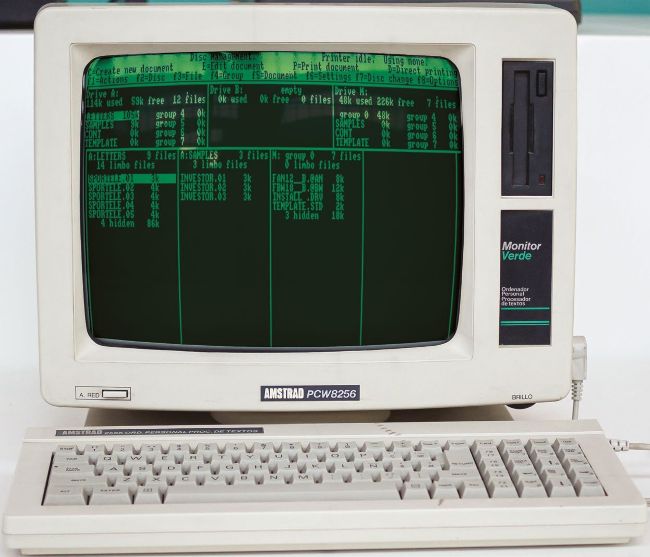
The PCW 8256 was nicknamed “Joyce” after Alan Sugar’s secretary
By this point, Lord Sugar had experience in the computer market. His CPC 464, 664 and 6128 computers – the first one being tape-based, the latter two using disks – were shifting many units and Amstrad, far from suffering the huge financial losses of its competitors, was making healthy profits.