Dogged Determination
Forty years ago this September, Kate Bush released Hounds Of Love. Her fifth studio record reinstated her position as one of the most innovative and creative artists of all time and yielded the (future) chart-topper Running Up That Hill. But its creation wasn’t always smooth. Here’s the story behind one of Bush’s best-loved albums.
Words: Jo Kendall Portraits: Guido Harari
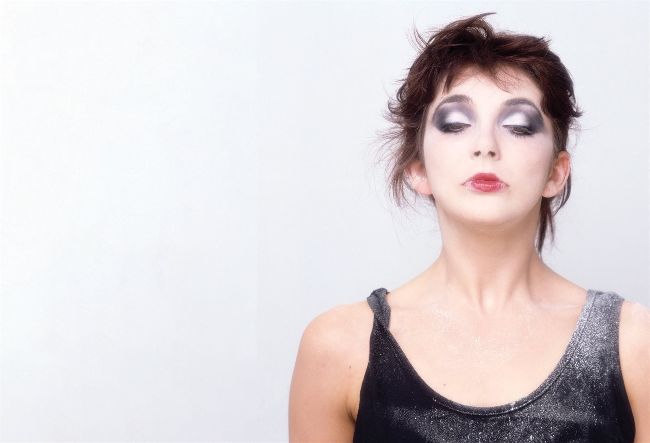
Bush needed to reinvent herself for her newest album – and thanks to technology, she did.
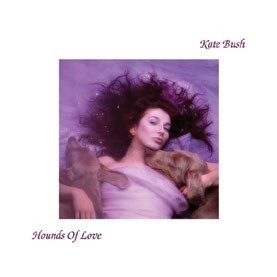
With her beloved pet pooches on the cover of 1985’s
Hounds Of Love
.
It’s 1983 and Kate Bush is, er, frankly, bushed. Five years previously, the symphonically spooky No.1 hit Wuthering Heights was the south London singer-songwriter’s hugely successful breakthrough – making her, aged just 19, the first female artist in global chart history to do so with a self-written song. Next came the astonishing The Kick Inside and Lionheart LPs, both released in 1978; her first No.1 album, Never For Ever in 1980; and, in the autumn of 1982, The Dreaming. On top of that there had been 16 singles, the six-week Tour Of Life in 1979, countless engagements around the world and a clutch of vocal collaborations, perhaps most notably for Peter Gabriel on his third self-titled record, aka Melt.
Each step had seen Bush bloom as a songwriter, vocalist, musician, performer, and now as a producer. In 1979 the 20-year-old tested the water alongside Lionheart engineer Jon Kelly for the live On Stage EP, then dived in further as co-producer with Kelly for Never For Ever. But it was with The Dreaming that the award-winning, fan-adored and muso-revered artist finally fully took the reins, yet this dramatic and theatrical masterwork devoured its architect’s time, energy and recording advance as she moved between multiple London studios, racking up hours of time and many packs of cigs, bars of chocolate and Chinese takeaways.
Increasingly, EMI became worried about their golden child’s experimental bent.
“It [was the] nearest album we ever returned to the artist,” A&R head Brian Southall remembered.
Meanwhile, in the studio, engineer Hugh Padgham, booked because of his work with Gabriel, recalled to Uncut: “I couldn’t bear it after a bit. She didn’t have any idea of the sonics and didn’t understand why, if you put 150 layers of things all together, you couldn’t hear all of them.”
The Dreaming was praised for its bold approach, but important outlets such as Radio 1 shrank away from promoting its outré singles, aside from the gloriously unhinged Sat In Your Lap.
“For the first time I was meeting resistance artistically,” Bush told Radio 1 in 1992. “People were saying, ‘She’s really gone mad now! Listen to this really weird record!’”
Although immensely proud of the work, which moved closer to her artistic ethos, the experience resulted in burn-out.
“I was just a complete wreck, physically and mentally. I’d wake up in the morning and find I couldn’t move,” she said. It was time to get out of London town and regroup.
Relocating to a countryside cottage near Sevenoaks in Kent with partner and bassist Del Palmer, Bush pottered around the garden and decompressed. They did normal stuff: listened to music, watched films, cooked healthy vegetarian food. Bush got back into a fitness groove with an inspirational new dance teacher, Diane Grey. From a music workroom window at the top of the house, Bush observed changes in the sky and atmospheric elements, as, that summer, ideas started to emerge for what was being termed ‘KB5’. Love, relationships, the natural world, esoteric literature, feminism, and old horror and war movies were instinctual sources for Bush to draw from as the more pop-structured songs Running Up That Hill (working title A Deal With God) and notably, with its eerie ‘It’s in the trees, it’s coming…’ soundbite from Jacques Tourneur’s 1957 horror classic Night Of The Demon, the title track Hounds Of Love, were fleshed out.