One planet, one man
As the critical climate talks come to Glasgow, a host who once aspired to be “world king” will truly have the fate of the Earth in his hands. But is Boris Johnson concentrating?
FIONA HARVEY
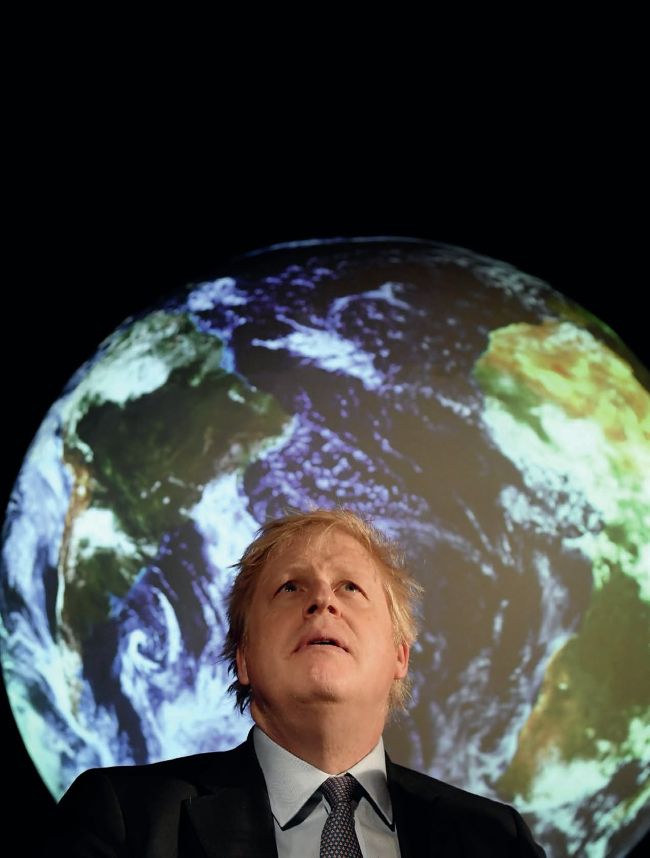
© EREMY SELWYN - WPA POOL/GETTY IMAGES
It was a sweltering late July afternoon in Kew Gardens with a thunderstorm in the offing and John Kerry, in a dark suit and sky-coloured tie, needed a chilled can of water and a discreet handkerchief as he stepped to the podium. But the former senator, presidential challenger and US secretary of state, who is now President Biden’s special envoy on climate, had a clear mission: to rally global action on the climate crisis.
The hard-hitting speech very deliberately put climate at the centre of US foreign policy: politely but firmly demanding co-operation from China, ramping up fears about the consequences of failure, while also keeping alive hope that this year’s “COP26” summit (ie, the 26th Conference of the Parties to the United Nations Framework Convention on Climate Change, or UNFCCC) could deliver the progress needed to halt climate breakdown. It was a bravura performance by one of the world’s most powerful statesmen. But nobody from the host government for those talks—that is, Boris Johnson’s administration—was there to hear it.
COP26, which opens on 31st October in Glasgow, is a twoweek meeting of world leaders, plus 30,000 delegates—the biggest diplomatic event on UK soil since the Second World War. As president and host, it falls to Britain to herd 196 governments into a deal that will fulfil the real but hazy promise of the previous agreement in 2015 in Paris. Delayed by a year due to the pandemic, it should be a last, best chance for the UK to prove there is some substance to its sometimes-mocked “Global Britain” pose.
More importantly, it may be the last realistic chance of staving off uncontrollable climate chaos. The biggest powers can see this: at the UN general assembly in September, Xi Jinping announced China would shut off finance to coalfired power plants abroad, while Joe Biden wrote an overdue cheque to help poor countries cope with the unfolding crisis. This creates an opening, but much more is needed—China will have to stop building coal stations at home, and that American cheque is going to need to get bigger. Many developing countries feel increasingly desperate for action, but few can afford to do much on their own. Meanwhile fossil fuel exporters, from Russia to Saudi Arabia and Australia, continue to sit on their hands. What’s sorely needed is an engaged and honest broker to seal a deal.
A question of leadership
As an environmental journalist, I have taken a ringside seat for 14 out of the last 16 COPs, the new form of international relations created when the UNF- CCC was signed in 1990. Climate negotiations have always been tortuous, sometimes disastrous and occasionally triumphant, but one thing has held true throughout: while scientists, businesses, passionate campaigners and technocrats are all involved, the outcome ultimately turns on the individual big players. Tom Burke, veteran government adviser who onceworked for Michael Heseltine before co-founding the green thinktank E3G, is emphatic: “Personal chemistry among leaders is enormously important.”
The 2009 Copenhagen summit subsided into mayhem after the poorly-briefed Danish premier Lars Løkke Rasmussen foolishly wrested control from his environment minister, without grasping the complexities of the process— it took Barack Obama, holding court in a small room with Chinese premier Wen Jiabao, to salvage a partial deal from the ruins. By contrast, the all-out “360 degree diplomacy” of President François Hollande paved the way to success in Paris six years later: for two years in advance, his ministers were sent round the world making demands. Many months before the meeting, Hollande himself was on the front foot, demanding a “miracle” of his fellow world leaders.