Divided we fall
The threat of a hard border between Northern Ireland and the Republic could derail Brexit
DARRAN ANDERSON
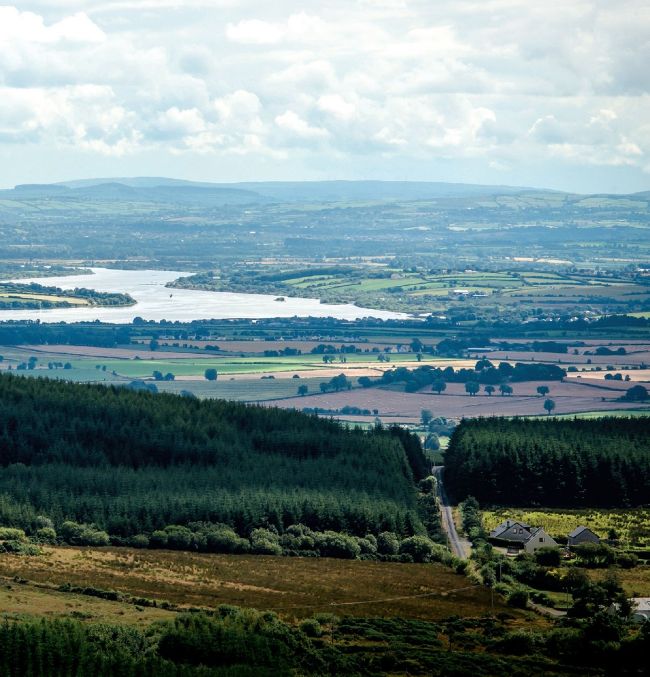
A view of the river Foyle, from Grianán hillfort, which defines part of the Irish border. Counties Londonderry and Tyrone in Northern Ireland are to the left of the river, and County Donegal in the Republic lies to the right
Crossing the border between Northern Ireland and the south, it’s sometimes difficult to tell when you leave the kingdom and enter the Republic. The traffic signs are different and there are subtle clues too in the changing colour of road markings and even the texture of the asphalt. Your mobile phone will slip in and out of networks for several miles. The feeling is of one country fading indistinguishably into another. All around, there are signs of the activities that thrive in liminal places; petrol stations and shops taking advantage of the differences in tax and exchange rates, skid marks on the roads from jurisdictionescaping joyriders, a hand-painted advertisement offering illegal “Red Diesel for Sale” discarded in a ditch.
Tied to a lamppost, near a defunct custom post, is a placard titled, “Respect the Remain Vote.” It continues, “Warning! If there is a hard border this road may be closed from March 2019.” It is signed, “Border Communities Against Brexit.” All along the 310-mile border between Northern Ireland and the Republic, such signs remind travellers and locals that the boundary will likely not remain invisible for long.
Ireland, north and south, is facing a border crisis. What is now a boundary between two European Union countries will soon be the Brexit frontline between the EU and the United Kingdom. When he visited the north in August, the new and decidedly worried Irish Taoiseach, Leo Varadkar, took a stark tone when he addressed a crowd at Queen’s University in Belfast. He said that “every aspect of life,” in the north could be affected—“citizens’ rights, cross border workers, travel, trade, agriculture, energy, fisheries, aviation, EU funding, tourism, public services, the list goes on.” Arguing the onus was on the hard Brexiteers to explain how all of these things could be function tolerably around the hard border that we appear to be drifting towards, he nonetheless offered up a solution of his own, for a new bespoke EU/UK customs union that could apply after the UK had left the customs union proper. But he didn’t explain how this would work. The truth is that everyone is clutching at straws.
Both sides in the Brexit negotiations have noticed that the vanished border’s role in keeping the peace in Northern Ireland gives it a particular charge; all the more so because the powersharing agreement in Stormont collapsed earlier this year and has struggled to recover. Michel Barnier, the European Commission’s Chief Negotiator for Brexit, has said that he wishes to avoid “a hard border, a new burden that is in contradiction with the Good Friday Agreement.” Varadkar made clear to the Belfast crowd that Ireland would expect no less, and would ensure it was high on the EU negotiators’ list of priorities. “We will do all we can,” he said, “in Brussels, in London and in Dublin.”