Pacific no more
We ignore the increasingly toxic rivalry between China and Japan at our peril, warns Rana Mitter
Rana Mitter
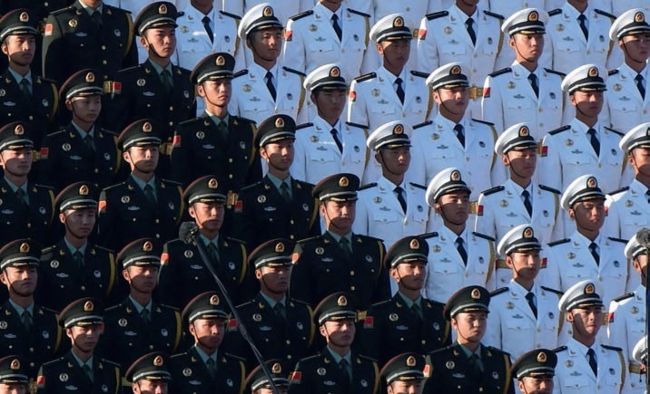
Battle hymn: a military choir in Beijing celebrates 70 years since victory over Japan
© GREG BAKER/AFP/GETTY IMAGES, JAN VERSWEYVELD
Asia’s Reckoning: China, Japan, the US and the Struggle for Global Power
by Richard McGregor (Allen Lane, £20)
The End of the Asian Century: War, Stagnation, and the Risks to the World’s Most Dynamic Region
by Michael R Auslin (Yale, £20)
If you want to see a great disappearing trick, just try looking for Asia coverage in a major American or British newspaper. A region that is home to half of the world’s population, a quarter of its economic power, and has the potential to blow up into several conflicts generally disappears into the odd story on page 18. In July, Sun Zhengcai, the party secretary of the Chinese mega-city Chongqing, was abruptly fired by Xi Jinping, the country’s president. This was an event easily equivalent to James Comey’s sudden departure as FBI Director. I don’t remember it getting much attention in the UK.
One of the reasons for Pacific Asia’s absence from the news is that word “potential.” During the Cold War, there were major wars in Korea, Vietnam and between India and Pakistan. In the past three decades, the region has been remarkably peaceable, with steady economic integration, a deepening security architecture, and—so far—three or four major powers who have managed, uneasily, to avoid conflict and tame the more exuberant members of the community. While the Middle East burns, Russia subverts elections and there is terror on the streets of Europe, “Beijing and Tokyo nearly clash offshore but step back after some growling” doesn’t really cut it as a news hook.
But we may not have a choice. In 2017, the number of flashpoints in the region is growing. There is nothing “potential” about North Korea’s nuclear capacity, the installation of Chinese military runways in the South China Sea, or the continuing friction between Japanese and Chinese vessels off disputed islands in the East China Sea. And the election of Donald Trump, whose view of geopolitics is fundamentally different from any president of the United States since the Second World War, is not so much a “black swan” as a grey geopolitical pigeon relieving itself from a great height on a highly sensitive region.