Imagining history
Alice Goodman tells Sameer Rahim how to write political operas— and mourns her husband, the poet Geoffrey Hill
Alice Goodman
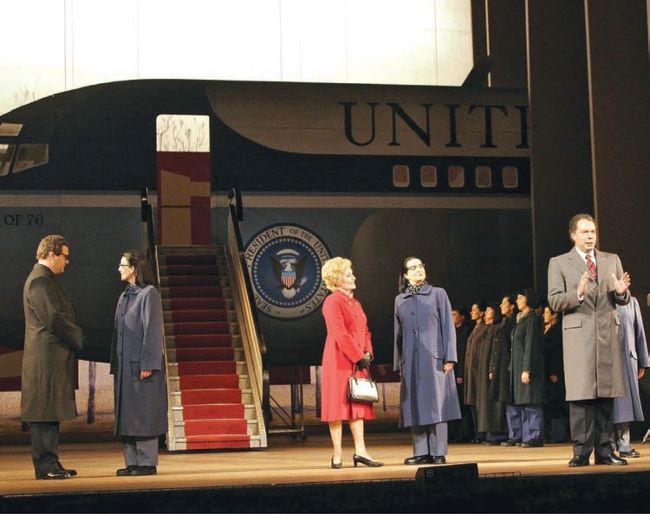
“News has a kind of mystery”: Nixon (James Maddalena) sings after touching down in Nixon in China
© JEFF J MITCHELL/GETTY IMAGES, RICHARD MORAN, PHOTOSTAGE
Four years ago, I spent a memorable afternoon with the poet and Anglican priest Alice Goodman and her husband the poet Geoffrey Hill. We were at the parish rectory in Fulbourn, a village near Cambridge, discussing Hill’s recently published Broken Hierarchies: Poems 1952-2012. That book was the culmination of an extraordinary life’s work that confirmed his position as England’s greatest living poet. He also had just been knighted—a rare honour for a writer. One of the most enjoyable aspects of our interview was the couple’s teasing repartee: at times, it felt as though they were improvising a Beckett play especially for me. But when I returned to the rectory in July, I spoke to Goodman in a more sombre mood. Hill had died almost exactly a year earlier, aged 84.
“It’s tough,” Goodman told me, wearing her on-duty black cassock and white collar. We were sitting in the same front room surrounded by portraits of Hill and photographs of his family. Milky light pierced the windows. “Nobody can quite tell you in advance what it will be like and however much you’ve been expecting it, it’s a shock.” Hill had been suffering from a number of “co-morbidities,” she said, including coronary problems, diabetes, “galloping” prostate cancer, as well as a “really spectacular depressive disorder,” about which he wrote with mordant vividness in his later poems.
When a writer dies the whole world wants a piece of him. Archivists from the Brotherton Library at Leeds University, where Hill taught for many years, were due to take possession of most of his books shortly. It would be a wrench. “They would have quite liked to have got his whole study complete with toy trains and old coins and paperweights and the contents of the bin and the desk chair,” she said. “They would have quite liked to have the chair you are sitting in—which is the chair he was sitting in when he died.” I shifted slightly in my seat.