CLIVE TOWNSEND
His name is one that will resonate with most ZX Spectrum fans in particular. Creator of the wonderful Saboteur games, Retro Gamer chats ninjas, rising robots, cataclysmic power cuts and more with Somerset’s most famous Speccy programmer
Words by Graeme Mason
Having engendered a programmer’s mentality early on in his life, Clive Townsend began coding on the Sinclair ZX81 before moving to its successor, the ZX Spectrum. The embodiment of a teenage coder, Clive created several games for his local software house, Durell Software, before working steadily in the games industry, following a familiar path of Game Boy, mobile and PC development throughout. Having rediscovered his ZX Spectrum roots with recent homebrew releases, it’s high time we learned more about the man behind one of the Spectrum’s most extraordinary series of arcade adventures. This is Clive Townsend, In The Chair.
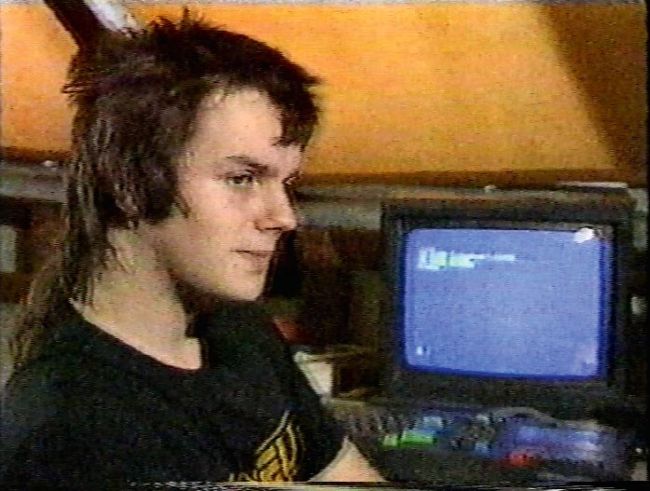
» A clip from Clive’s appearance on the BBC.
Hello Clive! Do you remember your first encounter with videogames?
Hello! I can’t remember the first game, but I remember being at school registration, and one of the guys wasn’t there. Someone said, “He’s at the railway station, playing Space Invaders!” and I had visions of him running around with his arms out pretending he was a rocket, and it turned out it was a computer game! That was the first time I’d ever heard of one.
Do you remember your first encounters with computers?
We didn’t have computers at school until the fifth year when the school got an RM380Z, a big old beast of a machine with a green-screen monitor. We’d write programs on square paper and take turns trying our programs out.
And at home?
A friend of mine had a ZX81, and we typed in listings together, most of which didn’t work as there was always a typo somewhere. So, we had to debug to try and figure out how it worked. I think that’s where I started programming, and I was keen to get a ZX81 myself – until my friend told me the ZX82 was coming out. So I grovelled to my parents to get one as a joint Christmas and birthday present. And then my birthday, which is in June, came, and they actually got me a Spectrum! I started experimenting with the Speccy, making some games in BASIC, and discovered a compiler to speed up my code.
Did you try to sell these games?
Yes, I went to a local shop called The Spectrum Centre, which was actually a camera shop and had no relation to the ZX Spectrum. I said to the guy in there, “I’ve made some games, will you sell them for me?” They agreed but said a local software house was nearby that made real games.
Presumably Durell Software?
Yes, and I went off to see them. The first thing they said to me was, “Here’s a game called Jungle Trouble, we want to see if you can make a copy of it without using tape to tape,” – in other words, to try and crack the loader, which wasn’t too difficult!
How did you do it? I merged the BASIC instead of loading it so it didn’t autorun, and then I could see what was happening. That seemed to impress the boss, Robert James Durell White, which was where Durell’s name came from, and as I was only 16, he said I could return in the school holidays.
Did Durell offer you a job once you’d finished school?
They did, but I went to college, doing maths, physics and art. But back when I was at school, I didn’t like the head teacher, and it turned out that she’d moved to the same college! So, after about a year, I decided to take up the job offer. I went back to Durell, and fortunately, it was still there.