SEGA MEGA DRIVE
IF YOU WANTED ARCADE ACTION IN THE COMFORT OF YOUR HOME IN THE EARLY NINETIES, SEGA’S 16-BIT SYSTEM WAS THE MACHINE TO OWN. WE SPEAK TO THE DEVELOPERS WHO CRAMMED COIN-OPS INTO THE CONSOLE BACK THEN, AS WELL AS THOSE TAKING ON THAT CHALLENGE TODAY
WORDS BY NICK THORPE AND DARRAN JONES
It’s no secret that the Mega Drive was easily Sega’s most successful console, and there are a multitude of reasons for that. A certain speedy blue chap can rightfully claim some credit, innovative marketing definitely played a role and only a fool would ignore the popularity of Electronic Arts and its juggernaut sports games. However, the factor that is undoubtedly closest to the heart of the Mega Drive is its connection to the arcades – Sega built its legacy in the coin-op arena, and its expertise in that area of the business would shape every aspect of the console, from its hardware design and software library to even its marketing.
Development of the Mega Drive began in mid-1986. Hideki Sato, who headed up Sega’s home-console R&D division at the time, looked back on this time in the book Sega Consumer History. As translated by Shmuplations, he recalled, “By then, arcade games were using 16-bit CPUs. Arcade development was something we were very invested in, so we were always using the most cutting-edge technology there. Naturally, it started us thinking, ‘What if we used that technology in a home console?’” In the book Mega Drive/Genesis: Collected Works by ReadOnly Memory, Mega Drive hardware designer Masami Ishikawa explained that the key goals with the hardware were to have “the basic performance of the preceding system boards – the System I, System II and System 16”, while incorporating backwards compatibility with Master System games.
“PLAYING ALTERED BEAST IN-STORE, WITH ITS FLUIDITY, LARGE SPRITES, AND VIBRANT COLOURS, COMPLETELY BLEW AWAY MY AMIGA VERSION”
ANDREA BALDIRAGHI
Like the System 16, the Mega Drive would use a 16-bit Motorola 68000 as its main CPU and Zilog Z80 as a sound CPU, with a Yamaha synthesiser chip for audio. However, cost considerations kept the use of the 16-bit CPU in doubt until late on, and Ishikawa believed that Sato made the final decision on that issue. “By using the 68000 we could take advantage of the programming resources already available for arcade use,” he explained, though he did note that the company’s consumer game programmers were unfamiliar with the CPU. The custom graphics chip designed for the system was likewise subject to cost considerations, and compromises had to be made. “We wanted to include enlarging and minimising capabilities as well as sprite-spinning functionality, but the circuit design was becoming too large to fit on one chip, which would have lowered the production yield rate and hiked up costs, so we had to remove it from the spec,” recalled Ishikawa. The system’s colour palette was limited for the same reason.
Regardless, the Mega Drive was a powerful bit of kit when it finally launched in the Japanese market in 1988, as an anecdote from Sato confirms. “I remember very fondly a demonstration we did at an announcement party for the Mega Drive, where we took the Mega Drive version of Altered Beast and played it next to the arcade version, and there was almost no difference.” Early Japanese promotional materials for the console explained the benefits of the 16-bit CPU by telling readers that most arcade games were already using 16-bit technology, and promised “the same level of game content as in a game centre”. Sega chose to put the arcade connection front and centre in its international marketing too, with “We bring the arcade experience home” used as a slogan across early Genesis adverts in print and on TV. “For the first time, the powerful technology used in arcade games has come home to let you play games that look, sound and play exactly like they do in the arcade,” boldly claimed one magazine advert. Arcade games typically got top billing in the console’s advertising, with double-page spreads heralding the arrival of games like Golden Axe, After Burner II and Super Monaco GP. Likewise, “arcade quality graphics” was a key recurring phrase in UK adverts for the console.
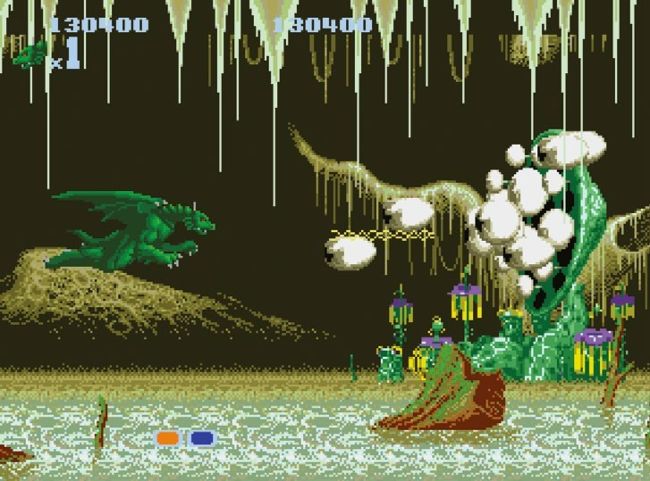
» [Mega Drive]Altered Beastwas a key early demonstration of the console’s power, and a good pack-in game.
Early press impressions of the Mega Drive highlighted the machine’s credentials as a capable conversion platform. Writing for Computer & Video Games, Jaz Rignall claimed that Altered Beast had “looks, sounds and playability that are indistinguishable from the coin-op” and said that Super Thunder Blade and Space Harrier II offered “smooth 3D update and wonderful graphics that put the majority of existing 16-bit titles to shame”. Over in the US, Video Games & Computer Entertainment ’s Andy Eddy felt that Altered Beast was “a good choice to be bundled with the console; it shows off the superior visual and aural capabilities of the Genesis as well as being a popular arcade game”. Not everybody was thrilled, though. In Electronic Gaming Monthly, Steve Harris cast doubt on the early software, saying that, “Sega does have an advantage in recognisable arcade titles […] but these initial attempts do not take full advantage of what the machine can do.”