“TOUCH THE MOON” WITHOUT LEAVING EARTH
Discovering Similarites Between Space and the Upper Midwestern U.S.
STORY AND PHOTOS BY JORDAN D. MARCHÉ II
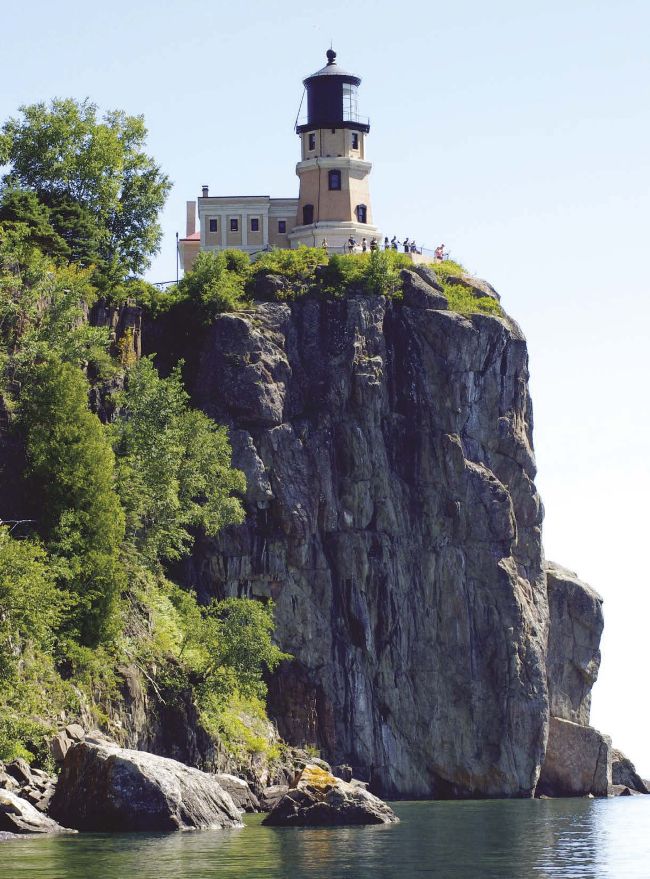
Split Rock Lighthouse and anorthosite cliffs beside Lake Superior in northeastern Minnesota.
The next time you glance up at the Moon (if more than just a narrow crescent is visible), take an extended look at what you see. Even with the unaided eye, or better still, with a pair of binoculars, you’ll note that there are two different types of landforms visible on its surface.
One of these is the lighter-colored, more rugged lunar highlands, while the other consists of the darker-colored, relatively smooth lava plains or lunar maria (plural of mare – the Latin word for “sea”). The older (and heavily cratered) highlands resulted from the cooling of a “magma ocean” that once blanketed the Moon’s surface. By contrast, the younger and roughly circular maria are remnants of former giant impact basins that afterward became filled with flood basalts from the Moon’s interior.
Six pairs of Apollo astronauts visited the Moon’s surface from 1969 to 1972 and returned with more than eight hundred pounds of lunar rocks (see Steve Voynick’s article, “Minerals of the Moon,” January 2020 Rock & Gem). Scientific analysis of these samples (which remains an ongoing endeavor) has told us a great deal about the makeup of our nearest neighbor in space. In turn, radioactive dating of these rocks has enabled us to reconstruct an accurate chronology of the Moon’s leading geological events –– a history stretching back roughly 4.5 billion years before the present. At the same time, these lunar rocks provided evidence for a dramatic new theory of the Moon’s origin (see ahead), one that likewise explains the cause of its former magma ocean.
ANORTHOSITE
The lunar highlands are composed chiefly of aluminum- and calcium-rich silicate rocks of a type known on Earth as anorthosite –– a coarse-grained, intrusive igneous rock “consisting mostly of calcic plagioclase (> 90%, usually labradorite) with < 10% mafics” (i.e., darker, ferro-magnesian minerals such as pyroxenes). Another name for “calcic plagioclase” is the mineral, anorthite (CaAl2 Si2 O8 ), from which the rock’s name itself is derived. Anorthosites differ from most other igneous rocks (e.g., granites) because of their almost complete absence of quartz. On Earth, anorthosites are relatively rare and have been broadly classified in the same group as the gabbros (low-silica, mafic intrusive rocks) and diorites (those of intermediate composition between mafic and lighter-colored felsic rocks) (Mindat.org).
Terrestrial anorthosites are usually found among the oldest parts of the continental crust, although why this should be so isn’t clear. According to one earlier theory (perhaps no longer supported), anorthosites might have composed the first solid crust on Earth (Peter Francis, Volcanoes (1976), p. 335). In North America, anorthosites are most readily found within the Precambrian Grenville Province of southeastern Canada and Labrador, where they have ages of around 1.6 billion years. But they are much more widespread than that.