LABRADORITE
A Feldspar Mineral with a Rainbow Inside
Collectors often dig labradorite as a colorful rock, but it is actually a mineral, not a rock. It is one of a half dozen varieties of feldspar divided into two groups that make up the crust of the earth. One group is the potassium feldspars, including microcline. The other group is a plagioclase feldspar, including labradorite.
STORY BY BOB JONES
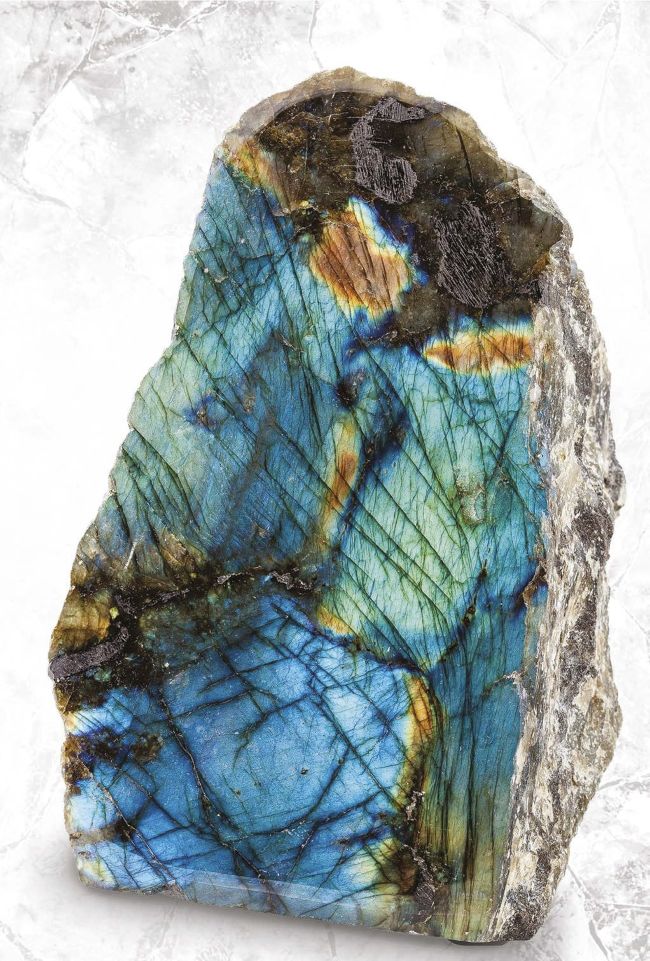
This huge standup of Labradorite from Madagascar has an amazing schiller to its polished window face which highlights the incredible blue Labradorescence of the highly decorative material
HERITAGE AUCTIONS
Labradorite occurs in two forms, massive rock outcrops useful in construction and lapidary work. It is also found in small crystalline and gemmy phenocrysts in volcanic rock suitable for faceted jewelry. It is most often found as huge rock masses that outcrop in areas as part of huge plutonic intrusive formations. These rock-like masses of labradorite often show various colors that flashback at the viewer when the rock is tilted and moved. The crystalline gem phenocrysts are much less common and can be a variety of colors. With a hardness of six to six and one-half, they can be used as faceted gemstones when properly set.
The remarkable play of colors seen in massive labradorite is predominantly blue, but flashes of bronze, golden, red, green and yellow show up as a piece is rotated or moved under a strong light source. Both exciting massive and gemmy types of labradorite can be self-collected. Outcrops of massive labradorite are found in a host of countries, including the United States, where it has been mined as a decorative stone for carvings and less often for jewelry.
CANADIAN DISCOVERY