HEALTH
Breathe easier...
Snoring can be caused by a serious but under-diagnosed condition called obstructive sleep apnoea. But new treatments offer hope for those afflicted - and their long-suffering bedfellows too
by PATSY WESTCOTT
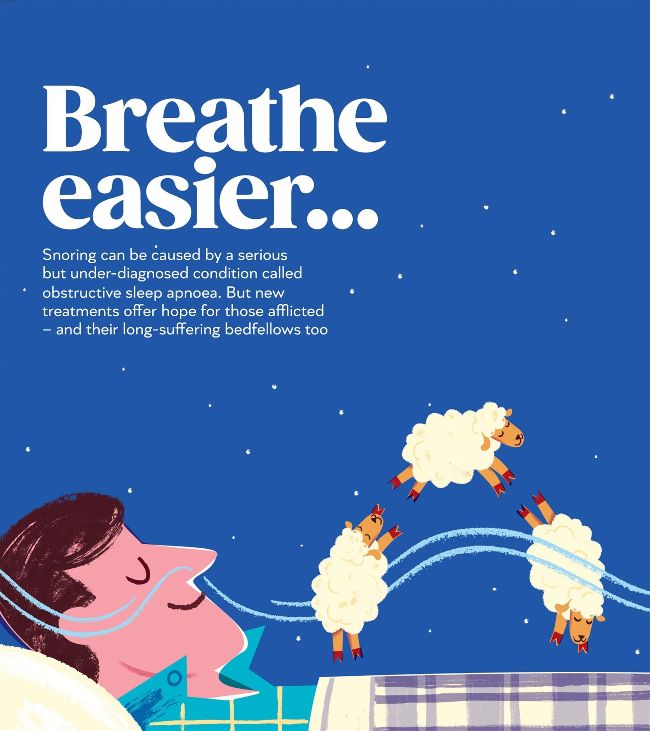
illustration IKER AYESTARAN
Office worker Gerard Cowie's snoring was so bad his former landlady swore she could hear him through two walls. Like many loud snorers, however, his problem turned out to be more than just noisy nights: it was caused by obstructive sleep apnoea (OSA), a shortage of oxygen caused by blockage of the upper airway.
Now, 13 years after being diagnosed, Gerard has become one of the first patients in the UK to undergo a new operation called hypoglossal nerve stimulation. It involves implanting a small pacemaker-like device under the skin of the chest. Sufferers turn it on via a remote control before sleep and, once activated, it stimulates the hypoglossal nerve that controls the tongue muscles, preventing the tongue from blocking the airway.
Guy's and St Thomas' NHS Foundation Trust in London is the first in the UK to adopt the procedure - also called Inspire - although it's been used for longer elsewhere in the world.
The first patients have experienced great improvement, according to consultant ENT surgeon and laryngologist Yakubu Karagama. 'It's not for everyone but, for carefully selected patients with moderate to severe sleep apnoea, it can be a game changer,' he says. 'It involves making two five-centimetre cuts - one in the right of the chest and one under the chin - and takes around an hour. While it's done as a day case elsewhere, because it's new here and it involves a general anaesthetic, we keep patients in for 24 hours.'