Chris Spivey
Chris Spivey’s groundbreaking Harlem Unbound confronted the monster of racism as unflinchingly as the cosmic nightmares stalking the streets of New York. His next RPG, Haunted West, takes aim at the western
Words by Matt Jarvis
‘AS A BLACK KID IN SOUTHERN ALABAMA, HORROR IS A GENERAL ASPECT OF YOUR LIFE’
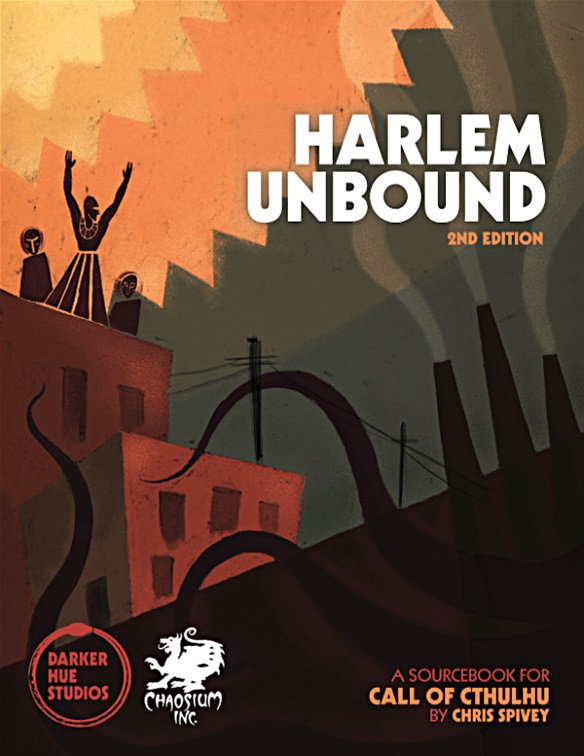
Main illustration of Harlem Unbound: Second Edition by Brennen Reece
For Chris Spivey, roleplaying and racism were intertwined from a young age. The future designer first discovered Dungeons & Dragons when he was around seven, picking up the RPG’s iconic Red Box to play with a friend.
“Even as we were flipping through it, we didn’t see anyone that looked quite like us, so that was a little disturbing even at that age,” Spivey says.
Shaken but undeterred, Spivey stuck with the game, eventually joining an Advanced Dungeons & Dragons group. A fondness for the fantasy stories of Michael Moorcock saw him then move on to Stormbringer, the roleplaying game based on Moorcock’s Elric of Melniboné books and built on the Basic Roleplaying gameplay of Chaosium’s RuneQuest. Spivey’s love of roleplaying soon led him to begin creating his own settings to explore.
“One of the first things I did was I actually made a sort of African fantasy world using some of the Stormbringer rules,” he recalls. “So around 12 or 13 I started designing and making games for myself.”
In his early teens, Spivey encountered the work of H.P. Lovecraft. The early 20th-century horror writer would further ignite the young designer’s passions.
“Around 14 or so, I was at an estate sale and I uncovered a book of Lovecraft’s work,” Spivey explains. “‘The Outsider’ really sort of spoke to me at the time.”
Spivey’s interest in Lovecraft led him to seek out Call of Cthulhu. Like Stormbringer, the horror RPG was built on the Basic Roleplaying system. In particular, Spivey was drawn to Dead Man Stomp, a 1920s-set scenario starring a jazz musician in possession of a trumpet said to have been Louis Armstrong’s own. (Spivey would later update the classic adventure for a 2018 re-release, something he would call “one of the highlights of my life”.)
“That solidified me as a Call of Cthulhu player,” Spivey recalls.
One of the things Spivey admired most in Call of Cthulhu was the game’s real-world setting, which served as a background to all manner of nightmarish cosmic horror and supernatural mystery.