To Hell with it
From the bloodstained streets of Baldur’s Gate to Hell itself, Dungeons & Dragons’ next adventure is its most infernal yet. Chris Perkins drags us into Avernus
Words by Matt Jarvis
D&D: DESCENT I N T O AV ERNUS
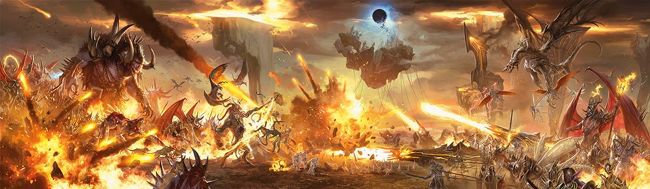
Main image by Daarken, all images courtesy of Wizards of the Coast
What does a chicken from the depths of Hell taste like? Venture into the first layer of Dungeons & Dragons’ Nine Hells and you might come across the common fowl’s abyssal cousin, which in Descent into Avernus can become familiars or food. Principal story designer Chris Perkins accepts that some players will immediately spark up a fireball barbecue, just to see how the demonic equivalent of a cheeky Nando’s goes down.
“We actually have talked about that in the adventure, because it’s going to come up!” he laughs.
Roasting chickens is one of the lesser evils going on in Avernus, which properly returns D&D to the Nine Hells for the first time since the fantasy RPG’s second edition almost two decades ago.
“We haven’t really done an outer-planer adventure for Fifth Edition yet, and we haven’t done a Hell adventure in a hell of a long time, since the Planescape days,” Perkins says. “So for us it was an opportunity to finally kind of pay off a promise that eventually we would go to the outer planes and visit them to some extent.”
Avernus also sees D&D head back to one of its most iconic cities, Baldur’s Gate, the backdrop for the seminal nineties computer games of the same name. It was the green light for Baldur’s Gate III, the first numbered entry in the series since 2000, that inspired the tabletop RPG’s team to return to the setting for the first time since Murder in Baldur’s Gate, a 2013 bridge adventure released between Fourth and Fifth Edition.
“Larian [Studios], who are doing Baldur’s Gate III, are huge D&D goobs,” Perkins says. “When they got on board to do a D&D story, we felt it was our imperative to tie our big story into Baldur’s Gate as well.”
Close to three years in the making, Perkins calls Descent to Avernus something different to previous Fifth Edition adventures, diving into the depths of Nine Hells lore – something rarely explored to this level in D&D canon.
“We had what I would consider to be the ideal amount of time to let the story percolate and then do some concept artwork ahead of time to kind of nail down some of the themes and the feel of the story, things like that,” Perkins says.
SIN CITY
Last year’s adventures Dragon Heist and Dungeon of the Mad Mage took place in (and in the case of Mad Mage, under) Waterdeep, the Sword Coast’s City of Splendours. Dragon Heist particularly ventured into some of the seedier parts of the city, exploring its criminal underbelly and the vigilant City Watch keeping order. But even Waterdeep’s most foreboding alleys pale in comparison to the lawless danger of Baldur’s Gate.
“Whereas in Waterdeep the city is likely to come down on you pretty hard for crimes, in Baldur’s Gate the characters can basically run around and kill people and do what they want – as long as they don’t get caught, they’ll be fine,” Perkins says. “There’s this sense of even adventurers in the city can be dangerous; the city itself is a like a dungeon in many respects.”
Releasing back-to-back adventures themed around cities is unusual for Dungeons & Dragons, but Perkins says that the stark contrast between Waterdeep’s vast, welcoming metropolis and the intimidating streets of Baldur’s Gate made the team keen to make it their next destination.
“With all the cities on the Sword Coast North, we wanted to kind of make sure they were all distinct in character from each other so that Baldur’s Gate felt very different from Waterdeep which felt very different from Neverwinter,” he says. “Baldur’s Gate we wanted to paint more like Gotham, where you don’t want to go through the streets without an escort because you’ll likely get murdered and robbed.