Reviews
RECORDINGS
OTTO VAN DEN TOOM
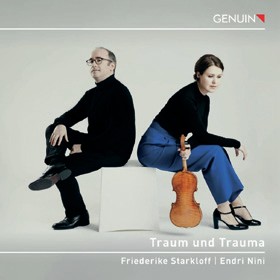
TRAUM UND TRAUMA
ANTHEIL Violin Sonata no.2 DEBUSSY Violin Sonata JANÁČEK Violin Sonata SCHULHOFF Violin Sonata no.1 op.7
Friederike Starkloff (violin)
Endri Nini (piano)
GENUIN GEN24870
An album celebrating a remarkable decade of musical invention
In this recording, violinist Friederike Starkloff and pianist Endri Nini present a mini-survey of shifting musical styles in the first quarter of the 20th century. They open with Erwin Schulhoff’s First Violin Sonata, written in 1913 when he was 19. In the first-movement Allegro risoluto quirky, jerky motifs give way to moments of lyricism, its language veering between Romantic and the verge of atonality. In the long lines of the following Tranquillo Starkloff is always lyrical, before bringing lightness and wit to the following Presto. She imbues the sprightly Allegro moderato finale with sparkling energy.
There is a good deal of sensitive, delicate playing in the first movement of the Debussy sonata, outlining its quixotic dramatic narrative. Starkloff includes some fruity portamentos, not all of them marked, and does so again in the following Intermède. In the finale she and Nini revel in Debussy’s extensive palette of colours.
She starts Janáček’s sonata with a super-heated flourish, presaging the fierce, emotionally wrenching outpourings to come. The Ballada has intimate delicacy, and the central Meno mosso of the Allegretto has a sense of gentle questing before the bleak dialogues of the final Adagio.
In George Antheil’s Second Sonata (1923), in which popular music meets the avant-garde, Starkloff is variously seductive, swinging and biting au talon, and makes the most of such instructions as ‘giggled’ and ‘a little “off”’. At the end Nini forsakes the piano for a couple of small drums. The recording is warm and clear.
TIM HOMFRAY
PÄRT ÜBER BACH
BACH Cantata ‘Ich hatte viel Bekümmernis’ BWV21: Sinfonia; ‘Double’ Concerto in C minor BWV1060R (version for two violins)
PÄRT Tabula Rasa; Collage über B-A-C-H; Silouan’s Song
Simone Lamsma (violin) Amsterdam Sinfonietta/Candida Thompson (violin)
CHANNEL CLASSICS CCS46624
A meeting of minds across the centuries in this imaginatively conceived album
This enterprising programme affirms Bach’s influence on Pärt’s stylistic development. The Amsterdam Sinfonietta offers a dramatic account of Pärt’s three-movement Collage, a significant turning-point after his self-confessed reverence for Bach and his discomfort with his own musical language. Based on the B-A-C-H motif, the work’s heart is its central Sarabande, in which Pärt’s ‘hateful’ music is juxtaposed with phrases from the Sarabande of Bach’s Sixth English Suite, lyrically rendered on the oboe. Pärt later drew invaluable sustenance from silence, something that features prominently in the text-based Silouan’s Song and the haunting ‘Silentium’ of his Tabula Rasa, in which his expressive ‘tintinnabuli’ idiom is used to striking effect. Simone Lamsma and Candida Thompson immerse themselves in a concentrated account of ‘Silentium’ and dispatch the technical pyrotechnics of the preceding (‘Ludus’) variations and cadenza with precision and aplomb.
Both works by Bach are arrangements, Lamsma and Thompson masquerading as interweaving oboist and violin in the cantata movement and performing the concerto in a thoroughly ‘modern’, largely unembellished manner. They play its Allegros with energy and buoyancy and, over a soothing organ backdrop, bring a seamless cantabile dialogue to the Adagio, even if their regular ritardandos at cadences of melodic handover become mannered. The resonant recording seems to transform the Sinfonietta into a much larger ensemble.
ROBIN STOWELL
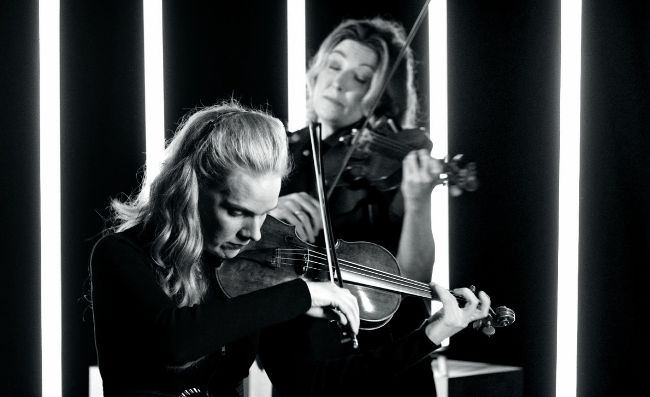
Thoroughly modern Bach from Lamsma and Thompson
To browse through more than a decade of The Strad’s recording reviews, visit www.thestrad.com/reviews
CHRIS O’DONOVAN