CARLO BERGONZI ‘SALABUE, MARTZY’ VIOLIN 1733
RESPLENDENT HARMONY
The 1733 ‘Salabue, Martzy’ is one of the finest instruments by Carlo Bergonzi in existence. Jason Price examines the violin and looks at its travels over the past 300 years
In
the 1730s Cremona was home to three master violin makers: Antonio Stradivari, Guarneri ‘del Gesù’ and Carlo Bergonzi. The Stradivari workshop was by then world-famous and ‘del Gesù’ was the third generation in a family of successful makers, but Bergonzi was the first in his family to take up the craft. He had no famous parentage or pedigree, and yet in around 1730 he burst on to the scene with his sensational, masterpiece violins.
Historically, Bergonzi was assumed to have been a student of Giuseppe Guarneri ‘filius Andreae’ but most experts now agree that he probably learnt the craft from Vincenzo Rugeri. While the influence of Guarneri is evident, Bergonzi’s social ties to the Rugeri family and the structural, technical elements of his construction methods suggest a relationship forged outside of the Amati–Guarneri tradition.
The back of the ‘Salabue, Martzy’ is made in one piece of beautiful, fully flamed, imported maple. We see the same wood in a number of other Bergonzi violins from this period including the ‘Earl of Falmouth’, the ‘Kreisler’, the ‘Knoop’ and the ‘Bennett, Reiffenberg, Brooks’. Interestingly, most Stradivari instruments from this period are made with either plain or domestic maple. Where did Bergonzi get his exceptionally fancy wood and, more importantly, how did he have a better selection than Stradivari?
The ‘Salabue, Martzy’ was built on the internal form known as MS1060, currently preserved in Cremona’s Museo del Violino. This form shares many similarities with the Stradivari moulds, also in the museum’s collection, including the system of ten anchor posts to affix the corner-blocks and ribs. The dimensions and proportions vary slightly between the Bergonzi and Stradivari forms, but the most significant difference is that Bergonzi’s upper corners are set higher and the shape of Bergonzi’s upper bouts is more of an inverted letter ‘D’, whereas Stradivari’s upper bouts resemble an upside-down Omega symbol (Ω). The shape of Bergonzi’s upper bouts does, in fact, more closely resemble the outline of Giuseppe Guarneri ‘filius Andreae’.
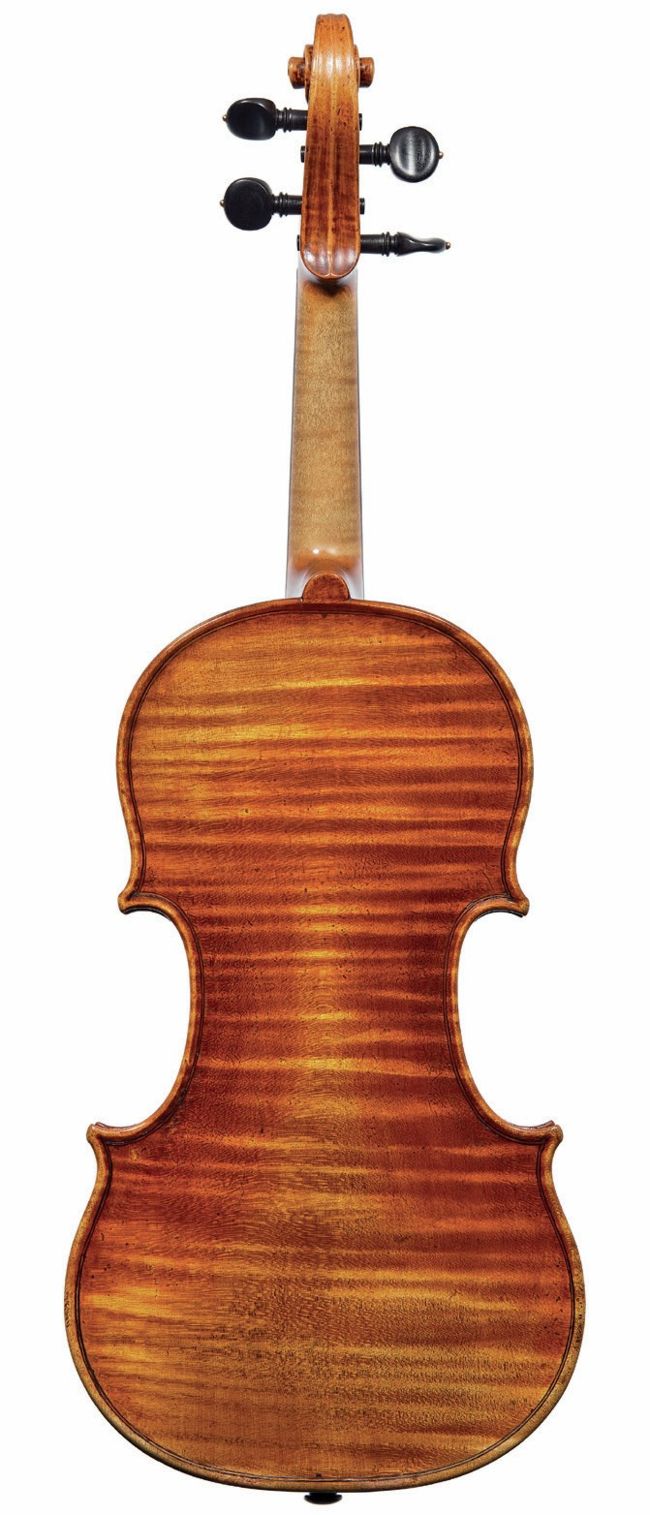
The ‘Salabue, Martzy’, the ‘Earl of Falmouth’ and the ‘Bennett, Reiffenberg, Brooks’, all from c.1732–36
ALL PHOTOS COURTESY TARISIO