GB
  
You are currently viewing the United Kingdom version of the site.
Would you like to switch to your local site?
14 MIN READ TIME

ANTONIO BAGATELLA

FIRST AMONG EQUALS

Despite few of his violins surviving today, Antonio Bagatella is important in violin history for writing one of the first treatises on instrument design. Christian Pabst examines his work and shows how his methods stand up to scrutiny

Very little is known about the life and work of Italian violin maker Antonio Bagatella (1716– 1806). Only seven violins made by him are known, along with a viola (and a piece of a broken back). However, he is of great interest to violin makers on account of having authored one of the first ever treatises on violin making in 1782: Regole per la costruzione de’ violini, viole, violoncelli e violoni. As well as being a historical document in its own right, it is remarkable in that its precepts hold up well for violin makers today, and that luthiers down the centuries have referred to its principles in their own work.

Bagatella was born in Padua and lived there for most of his life. For a limited time he probably worked together with his son, Francesco Antonio II Bagatella (1755–1829). What is otherwise known about his life was largely written down by him: he began playing the violin at the age of about 18 and was introduced to a local (unnamed) violin maker through the intervention of the violinist– composer Giuseppe Tartini (1692–1770), who also lived in Padua. He learnt his skills as a luthier from this master in secret, over the course of two years, after which he began making violins himself. It is reported that after a further two years he felt so competent and competitive that the other violin maker was compelled to leave town. There is evidence to suggest that this was either Giuseppe Galieri from Piacenza, a student of Nicolò Amati, or Giovanni Danieli from Padua.
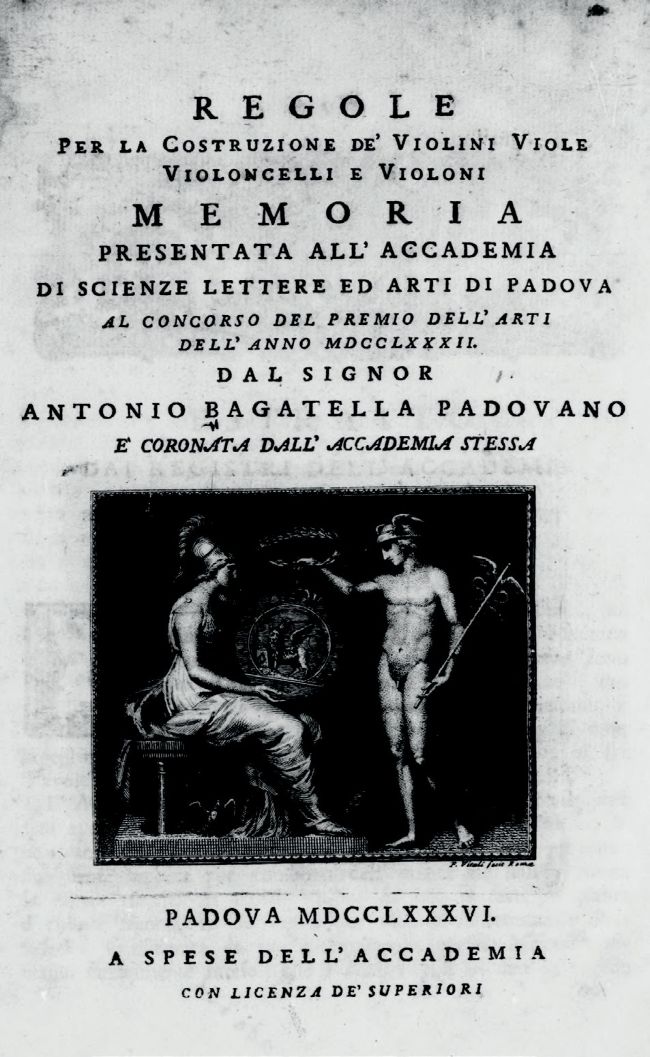
Title page of Bagatella’s 1782 monograph

Bagatella repeatedly refers to his good contacts with Tartini and his students. Through them, he gained access to instruments by the Amati family, Antonio Stradivari, the Rugeris and Andrea Guarneri. In his work he makes particular reference to the instruments of the Amatis and in particular to those of the Brothers Amati – although, according to him, his construction rules also work for the other Cremonese masters mentioned above.

Bagatella writes that he spent a decade searching for the rules and principles of instrument design, and that he used them for 30 years before committing them to paper. That would put his research around the year 1750. He explicitly refers to the ‘forgotten’ knowledge that he wants to explore – just around 15 years after Stradivari’s death, and only 120 miles from Cremona.

Read the complete article and many more in this issue of The Strad
Purchase options below
If you own the issue, Login to read the full article now.
Single Digital Issue March 2025
 
£5.99 / issue
This issue and other back issues are not included in a new subscription. Subscriptions include the latest regular issue and new issues released during your subscription. The Strad
Annual Digital Subscription £54.99 billed annually
Save
23%
£4.58 / issue

This article is from...


View Issues
The Strad
March 2025
VIEW IN STORE

Other Articles in this Issue


The Strad
Contributors
JOHN BASFORD (James Tubbs, page 42) gained a
SOUNDPOST
LETTER of the MONTH
Editorial
Editor's letter
This March, we celebrate the many talents of
FRONT
News
News and events from around the world this month
NEWS IN BRIEF
Orin O’Brien documentary receives Oscar nomination bit.ly/42w1Cs5 A
OBITUARIES
CHAIM TAUB Israeli violinist and pedagogue Chaim
Picture story
Images: courtesy RPO SYMPHONY OF COLOUR: A
Premiere of the Month
Arabic and Western musical techniques merge in a new piece for string orchestra
COMPETITIONS
Animato Quartet Tsukushi Sasaki Audrey Park ANIMATO PHOTO
NEW PRODUCTS
FEATURED PRODUCT
Life lessons
The German violinist on her influences and navigating today’s challenges
Opinion
Having made the difficult journey from an unbending conservatoire education to a fulfilling career playing and teaching non-classical styles, French violinist Scott Tixier says it’s essential to embrace diversity in music education
Postcard from Hanover
HANOVER
FEATURES
James Ehnes
Canadian violinist James Ehnes combines his virtuosity and musical intelligence as he takes a deep dive into the Bach violin concertos – both extant and reconstructed. He speaks to Thomas May about this latest chapter in his multifaceted career
D. C. Dounis
The Greek-born violinist and mandolinist D.C. Dounis was one of the most influential pedagogues of the 20th century, but his life and works still remain shrouded in mystery. Clifford Hall investigates why
James Tubbs
The British bow maker James Tubbs was born 190 years ago this month. John Basford looks back at his life, work and legacy to the bow making community
Session Report
Bulgarian violinist Liya Petrova tells Emma Baker about how her new album pairing Korngold’s Violin Concerto with Richard Strauss’s Violin Sonata came into being, and about striving for a sense of spontaneity
Zara Nelsova
The Canadian-born cellist Zara Nelsova was a fierce advocate for the repertoire she loved and for four decades an inspirational teacher at the Juilliard School. Oskar Falta explores her life and remarkable career, and hears from some of the musicians who studied with her
REGULARS
In Focus
A close look at the work of great and unusual makers
Trade Secrets
Makers reveal their special techniques
MY SPACE
LUTHIER
Making Matters
Points of interest to violin and bow makers
Masterclass
SCHUMANN FIVE PIECES IN FOLK STYLE OP.102, FIRST PIECE
Technique
Playing in the high register of the cello
Concerts
Your monthly critical round-up of performances, recordings and publications
RECORDINGS
AHO String Quartets nos.1–3 Stenhammar Quartet BIS BIS-2069
BOOKS
The Fractured Self: Selected German Letters of the
From the ARCHIVE
FROM THE STRAD MARCH 1915 VOL.25 NO.299
From the Archive
GERMAN FOCUS
Sentimental Work
FABIO BIONDI
Chat
X
Pocketmags Support