GB
  
You are currently viewing the United Kingdom version of the site.
Would you like to switch to your local site?
12 MIN READ TIME

LONDON CALLING

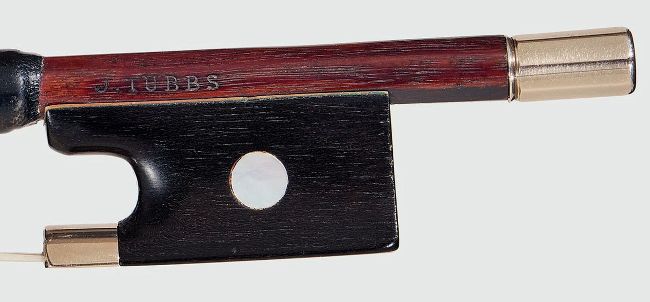
The British bow maker James Tubbs was born 190 years ago this month. John Basford looks back at his life, work and legacy to the bow making community

The 1876 Royal Academy of Music bow, sold by Tarisio, London, in October 2024
TARISIO

James Tubbs has had a bad press. Violin literature has characterised him as a drunk, from a family of drunks who lived dissolute lives. The facts indicate something quite different. His working life extended to over 70 years owing to his enforced return to work following the death of his son Alfred in 1909 (not 1912 or 1911 as in some previous printed/current online sources). If a successful working span of over 70 years is the result of a drunken, dissolute life, maybe more of us should try it.

James Tubbs was baptised on 28 June 1837 at St Mary’s, Lambeth. The address of his parents is given as Regent Street, Lambeth; his father listed as bow maker William Tubbs III (1814–78). By 1851, in the census of that year, James is already described as a violin bow maker living at the same address as his parents, 19 Princes Street, Soho.

He married in 1857 and around this time probably began his sometimes problematic connection to William Ebsworth Hill. Just five years later, W.E. Hill won a Prize Medal at the International Exhibition, London, for ‘good quality of tenor [viola], and excellence of bows’. However the bows, though entered by W.E. Hill and carrying his brand, were by Tubbs. This was a bone of contention between the two – when William Ebsworth formed his company W.E. Hill & Sons in 1880–81 it continued to claim the accolade. Tubbs gained revenge by overstamping bows he had made for William Ebsworth with his own name whenever they came into his hands.

After living at various addresses: Rupert Street; Great Windmill Street; Church Street; High Street, Marylebone; Greek Street and King Street, Tubbs finally moved to his long-time address at Wardour Street in 1872. In terms of marketing he was no slouch. In 1874 he became bow maker to the Duke of Edinburgh and in 1876 began an annual prize of a gold-mounted bow to be given to a student of the Royal Academy of Music. A similar prize was offered to a violin student of the Guildhall School of Music.

Read the complete article and many more in this issue of The Strad
Purchase options below
If you own the issue, Login to read the full article now.
Single Digital Issue March 2025
 
£5.99 / issue
This issue and other back issues are not included in a new subscription. Subscriptions include the latest regular issue and new issues released during your subscription. The Strad
Annual Digital Subscription £54.99 billed annually
Save
23%
£4.58 / issue

This article is from...


View Issues
The Strad
March 2025
VIEW IN STORE

Other Articles in this Issue


The Strad
Contributors
JOHN BASFORD (James Tubbs, page 42) gained a
SOUNDPOST
LETTER of the MONTH
Editorial
Editor's letter
This March, we celebrate the many talents of
FRONT
News
News and events from around the world this month
NEWS IN BRIEF
Orin O’Brien documentary receives Oscar nomination bit.ly/42w1Cs5 A
OBITUARIES
CHAIM TAUB Israeli violinist and pedagogue Chaim
Picture story
Images: courtesy RPO SYMPHONY OF COLOUR: A
Premiere of the Month
Arabic and Western musical techniques merge in a new piece for string orchestra
COMPETITIONS
Animato Quartet Tsukushi Sasaki Audrey Park ANIMATO PHOTO
NEW PRODUCTS
FEATURED PRODUCT
Life lessons
The German violinist on her influences and navigating today’s challenges
Opinion
Having made the difficult journey from an unbending conservatoire education to a fulfilling career playing and teaching non-classical styles, French violinist Scott Tixier says it’s essential to embrace diversity in music education
Postcard from Hanover
HANOVER
FEATURES
James Ehnes
Canadian violinist James Ehnes combines his virtuosity and musical intelligence as he takes a deep dive into the Bach violin concertos – both extant and reconstructed. He speaks to Thomas May about this latest chapter in his multifaceted career
D. C. Dounis
The Greek-born violinist and mandolinist D.C. Dounis was one of the most influential pedagogues of the 20th century, but his life and works still remain shrouded in mystery. Clifford Hall investigates why
Session Report
Bulgarian violinist Liya Petrova tells Emma Baker about how her new album pairing Korngold’s Violin Concerto with Richard Strauss’s Violin Sonata came into being, and about striving for a sense of spontaneity
Zara Nelsova
The Canadian-born cellist Zara Nelsova was a fierce advocate for the repertoire she loved and for four decades an inspirational teacher at the Juilliard School. Oskar Falta explores her life and remarkable career, and hears from some of the musicians who studied with her
Antonio Bagatella
Despite few of his violins surviving today, Antonio Bagatella is important in violin history for writing one of the first treatises on instrument design. Christian Pabst examines his work and shows how his methods stand up to scrutiny
REGULARS
In Focus
A close look at the work of great and unusual makers
Trade Secrets
Makers reveal their special techniques
MY SPACE
LUTHIER
Making Matters
Points of interest to violin and bow makers
Masterclass
SCHUMANN FIVE PIECES IN FOLK STYLE OP.102, FIRST PIECE
Technique
Playing in the high register of the cello
Concerts
Your monthly critical round-up of performances, recordings and publications
RECORDINGS
AHO String Quartets nos.1–3 Stenhammar Quartet BIS BIS-2069
BOOKS
The Fractured Self: Selected German Letters of the
From the ARCHIVE
FROM THE STRAD MARCH 1915 VOL.25 NO.299
From the Archive
GERMAN FOCUS
Sentimental Work
FABIO BIONDI
Chat
X
Pocketmags Support