ADULT LEARNERS ON THE CELLO
THE DEEP END
Billy Tobenkin, who began playing the cello aged 25, explores his own experience of learning Bach’s Prelude in G major after only a few months, and why he believes it is beneficial for adult learners to dive straight into ‘grown-up’ repertoire – offering tips on how to proceed
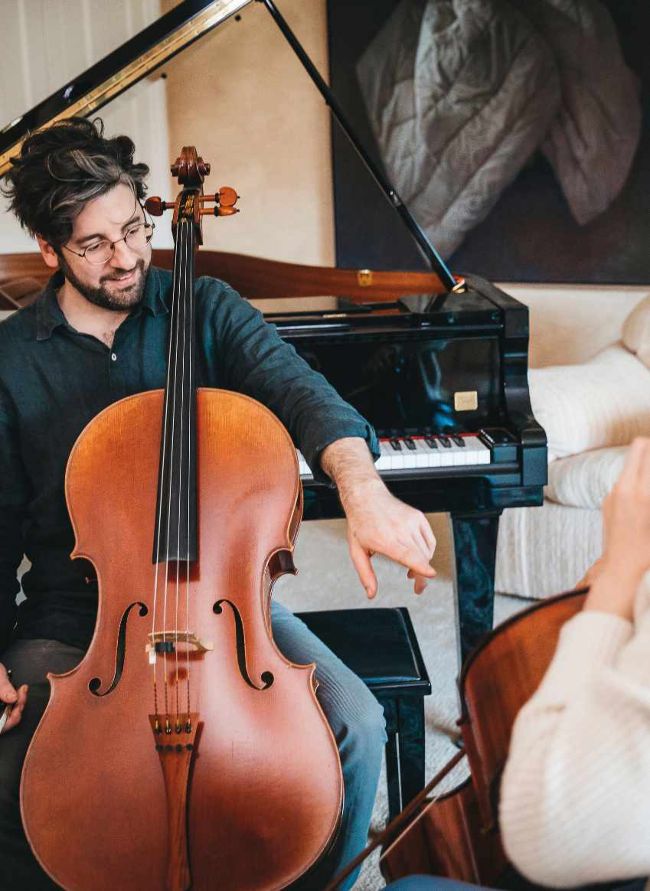
Billy Tobenkin in his teaching studio
Picking up the cello as an adult can be a bit like living in one of those small frontier towns in the days of the Wild West. There are rules, regulations and even a sheriff (your teacher), but things can often feel a bit more lawless and unstructured than life in the big city. Out here there’s no telling what can happen next, especially when it comes to choosing repertoire.
Having started the cello from scratch at 25, I found myself in such a situation. After a few months of hard work and rapid progress, I asked my teacher if I could start learning the famous Prelude from Bach’s Cello Suite no.1 in G major BWV1007, to which she agreed.
It was at this point that a strange chasm seemed to open before me. Here I was, working on a bucket-list piece after having started on the instrument only recently. Part of me was, understandably, absolutely thrilled to be working on a real cello masterpiece, but there was another part of me that felt a bit disappointed. I felt that I was likely skipping steps and breaking some unwritten law of what a real player’s journey should look like. I wondered if it was in my best interests as a serious student of the cello to be working on a piece like the Prelude so early on, and I yearned for the structure, rigidity and predictability of the standard syllabus that children enjoy.
Looking back now, I can say that the benefits of learning the Bach Prelude ‘too early’ far outweighed the costs. It was an exhilarating experience, and it stoked the fires of my passion to turn myself into a cellist and a musician.
In the case of adult learners, I believe it’s necessary to reimagine the repertoire and introduce ‘real’ pieces of music at a far earlier point in their journey than is the current standard. However, unlike the slapdash approach I took to conquering repertoire through sheer grit and dogged repetition, I want to propose a hybrid approach of having your cake and eating it too: working on musicality and technique through careful deconstruction of the piece.