DEALING WITH A BUZZ
WHAT’S THE BUZZ?
Finding why an instrument buzzes while playing is a task that bedevils luthiers. Dmitry Tarakanov presents a checklist for the most likely causes
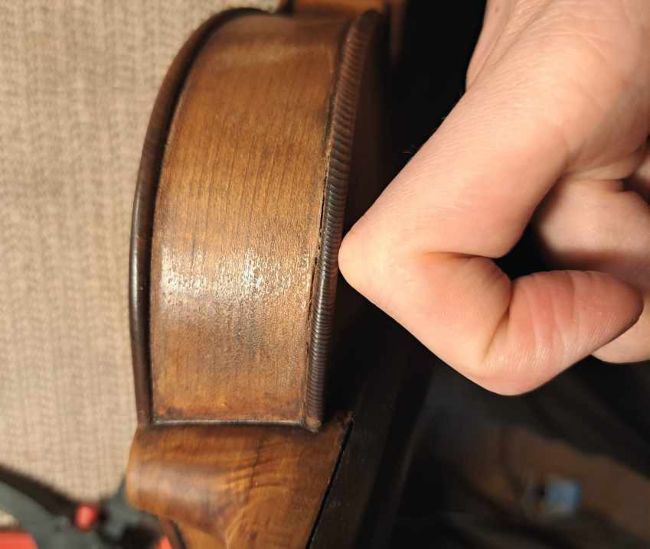
FIGURE 1 Knocking on an open edge
Sometimes, looking for the part of an instrument that’s causing it to buzz is a task that can flummox even the most experienced luthier. The rattle resonates all over its body and we can hardly rely on our ears as we search for the place to blame.
Often our eyes are no more helpful than our ears for this task, as the area that is buzzing might not be easily seen. All we can do is to check the instrument, part by part, to find the reason for the unwanted sounds.
Over the past couple of years I’ve been inspired to combine all of the reasons for an instrument buzz into one checklist, with short instructions (where needed) on how to solve each particular problem. I have found it a useful guide in the dark, tangled forest of unwanted sounds. Here is the full list in its entirety. I’ve organised the reasons from the most to the least common, in my experience. It should be noted that this list is intended for fellow luthiers; nearly all these repairs should only be attempted by professionals, especially where glue is concerned.
Unglued places around the edge. These could be open seams or unglued corners. To look for those, you can hold your instrument by the neck and gently knock the body all around the edge with a knuckle (figure 1). The sound of an open seam will be fairly obvious; you’ll get a feeling that something is loose there. Often the open seams are visible to the naked eye. Make sure to check the place that is clamped by a chinrest. To find an unglued corner, you can slightly push the corners one by one out of the block. All loose and open spots should be glued.