MAKING MATTERS
With 20 per cent extra
Points of interest to violin and bow makers
Five-string cellos are becoming increasingly popular, and not just for playing Bach’s Suite no.6. David Folland gives some practical tips, based on his recent experience of building one
Lutherie
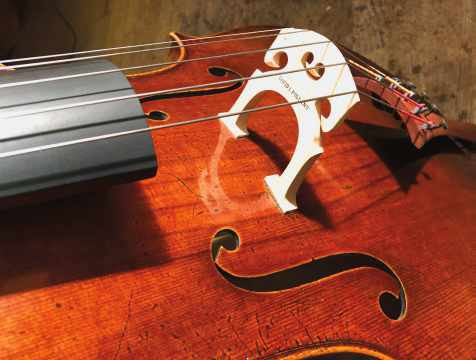
The five-string bridge needed to be designed from scratch
Cellists are aware that Bach’s Cello Suite no.6 BWV1012 was written for an instrument other than the four-string cello. It may have been the violoncello da spalla, essentially a small cello played like a viola. Using a five-string cello with a high E string greatly facilitates the playing of this suite. This cello, which originally had gut strings, required a shorter body and string length than a standard full-size cello; using a gut E string works much better at a shorter length because the tension can be lower. Tensioning a full-length gut E string to pitch can strain the limits of the material, so most five-string cellos are sized similarly to a 3/4 size, which can compromise their size of sound. However, with the advent of modern composite strings, several string manufacturers now produce a high cello E string that is very suitable for use on a full-size cello, enabling five-string players to produce a bigger and more powerful sound, particularly on the G and C strings.