NUGGETS
Almost Famous
Over 50 years on from its release, NUGGETS remains one of the most influential and beloved compilation albums of all time. But what of the bands who appeared on Lenny Kaye’s original anthology? Nick Hasted tracks down 10 of the Original Artyfacts to discover what happened next. Stand by for stories of Beatles tour supports, getting high with Gram Parsons, exploding stages and JFK conspiracies told to us by… a messianic rabbi, a car dealer and a building contractor among others. “We played hard, people danced hard and everybody drank beer,” remembers one former bowl-haired mysterioso. “We rock’n’rolled ’til the crack of dawn.”
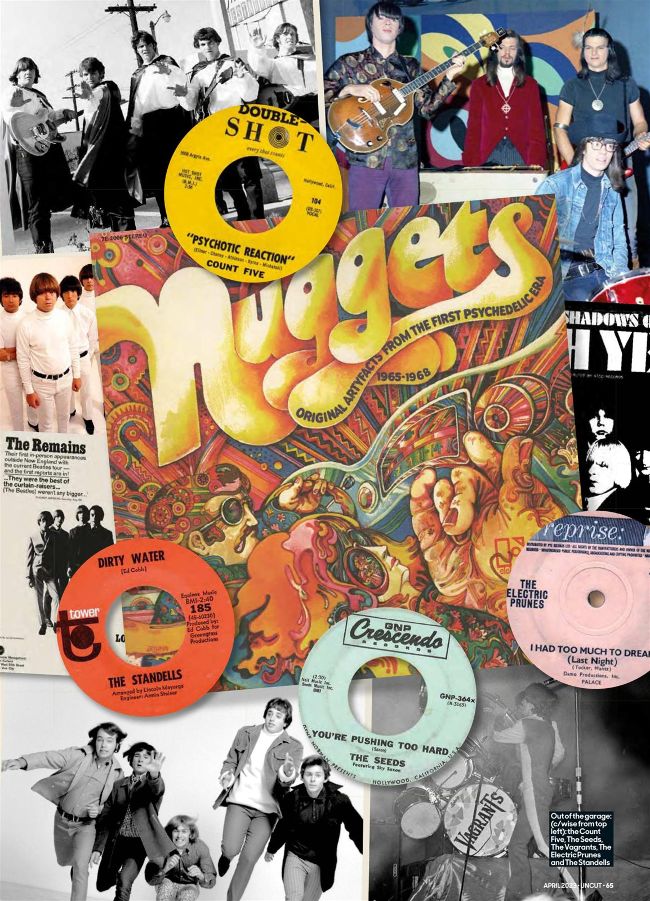
ODY 1970, Lenny Kaye was working at Village Oldies record store in New York’s Greenwich Village. He was holding down other jobs too – as a fledgling rock critic and as a freelance talent scout at Jac Holzman’s Elektra records. In the autumn of that year, Holzman came to Kaye with an idea: to collect tracks by bands that might otherwise have been lost or overlooked at the time. Kaye took inspiration from his own formative musical experiences in the Vandals and the Zoo – just two of the countless bands switched on by The Beatles’ first appearance on The Ed Sullivan Show on February 9, 1964. The ripples of this Big Bang moment spread across the States, mutating and amplifying into primitive garage rock, proto-punk and baroque psychedelia, leaving in its wake a slew of exhilarating 45s before many of these bands combusted, got drafted into the war in Vietnam, went to college or simply faded into obscurity.
This, then, is the compelling creation myth behind Nuggets: Original Artyfacts From The First Psychedelic Era – the album Kaye eventually compiled for Holzman. “It pays tribute to the music that caused me to pick up an electric guitar,” explains Kaye. “That initial spark of wanting to understand who you could become. The record is about desire.” Kaye worked instinctively, assembling a tracklisting where one-hit wonders jostled with local sensations and under-the-radar gems. “Now I can see the consistency of scene and genre,” he admits. “Then it just seemed a bunch of great records. If you were to come over to my house in 1971, these are the records I would have spun.”
The album might not have sold well in America when it was released in 1972, but Kaye found a different story overseas. “On our first European tour [with Patti Smith], somebody from the crowd asked me, ‘When is the next Nuggets coming out?’ In America, the 13th Floor Elevators had a medium-sized hit and I’d heard Mouse And The Traps on Top 40 radio. But the impact was revelatory in Europe, because nobody had ever heard these records before. Suddenly you had this encapsulation of what became known as garage rock.”
An American reissue in 1976 proved timely. “You could hear Nuggets’ beating heart in the CBGB bands,” acknowledges Kaye. Although Kaye’s plans for a second volume never came to fruition, collections inspired by Nuggets continued to mine this rich seam of rock’s forgotten history. “With Pebbles, Boulders and Rubble, all these other records have been exhumed too. Music is such a vast archive of wishes and dreams.”
But what happened to the bands who appeared on Kaye’s original compilation? When Uncut talks to 10 Nuggets bands today, we hear stories from a dizzying variety of afterlives – from missionary to jailbird to a cameraman on one of the most successful films of all time. Most poignantly, these former teen upstarts are all still playing music. When Uncut calls up Roy Chaney, bassist from the fabled Count Five, his band are about to start rehearsing “Psychotic Reaction” in preparation for forthcoming dates.