THE 1928 OLYMPICS SCANDAL
It’s 1928. The starting pistol fires in the women’s 800m final… what happens next shapes the course of women’s sport for decades to come
Words: Roger Robinson
On 2 August, 1928, seven women broke the 800m world record in the Amsterdam Olympics, the first games to include any women’s track races. It was the greatest ever leap forward for women’s running.
On 3 August, 1928 – one day later – an orchestrated litany of fake news reporting ridiculed the 800m runners for collapsing exhausted and sobbing, even before they finished the race. Conspiring officials promptly cut the event from the Olympic programme, setting women’s running back by 30 years in the process.
That sensational dual narrative, a story of pioneer achievement and perfidious misrepresentation, is a defining moment in the history of women’s sport. It shaped (or misshaped) belief about women’s capability for half a century and it has been wrongly retold for nearly 100 years.
Back to the start
The story began with a French rower, Alice Milliat, who protested against women being confined to sports that focussed on them looking pretty. Women had been admitted to the Olympic Games since 1900, but only in events deemed suitable for their frailty and appearance, like tennis, golf, archery, skating and swimming. The Olympics’ founder and president, Pierre
de Coubertin, had made his belief clear in 1912 that “the Games are a solemn exaltation of male athleticism, with female applause as reward.”
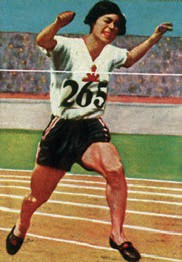
Below left: Lina Radke (1903-1983) was the first Olympic champion in the women’s 800m, winning a gold medal at the 1928 Summer Olympics, held in Amsterdam. Japanese athlete Kinue Hitomi (right) won silver and was the first Japanese woman to ever win an Olympic medal. Images from Die Welt in Bildern cigarette card album, circa 1928
After World War 1, when women had done plenty of tough driving, factory work and horrific nursing, Milliat led a campaign to break from this role as an adoring applauder. She initiated a women’s sport federation and a rebel Women’s Olympic Games, held in Paris in 1922. A one-day event, it attracted a reported 20,000 spectators, and she followed it up with an even more successful event at Gothenburg in 1926.
The International Olympic Committee (IOC) wasn’t amused. Milliat’s women’s festivals pressured them into including 10 women’s track and field events in the 1928 Olympics, as a trade-off for Milliat agreeing to drop the word ‘Olympic’ from her own events. She subsequently renamed her 1930 and 1934 events the Women’s World Games.
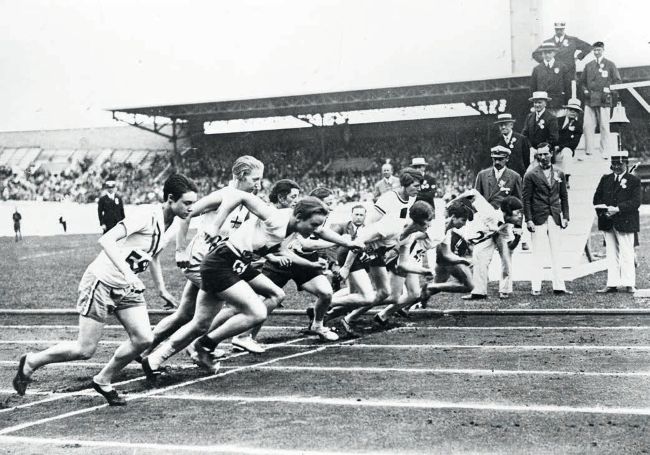
The competitors at the start of the final of the women’s 800m at the 1928 Summer Olympics. The runners are Lina Radke (1903- 1983), Kinue Hitomi (1907- 1931), Inga Gentzel (1908-1991), Jean Thompson (1910- 1976), Bobbie Rosenfeld (1904- 1969), Florence MacDonald (1909-2008), Marie Dollinger (1910-1994), Gertruda Kilosowna (1913-1938) and Elfriede Wever (1900-1941)
Late in the lead-up to 1928, the IOC suddenly cut the added events from 10 to five, a move that looked devious to say the least. Great Britain’s women’s team certainly thought so, and boycotted the games in protest. That sadly deprived the 1928 800m race of some top track and cross-country runners, such as Gladys Lunn from Birmingham, a potential gold medallist.
Despite the reduction in events, this new Olympic incentive brought women to tracks around the world, with 13 nations on four continents sending competitors to Amsterdam for the 800m. It was proof that there was global demand and having 25 entrants meant they needed three heats to reduce the field to nine for the final. And that brings us back to the historic events of the hot and humid afternoon of 2 August.
Publish and be damned
“Women Athletes Collapse – Fierce Strain of Olympic Race – Sobbing Girls” screamed the headline in the Daily Mail.