THERMAL ENVELOPE
Pay attention to insulation, airtightness and thermal mass, and you can achieve a home that’s comfortable, efficient and future-ready
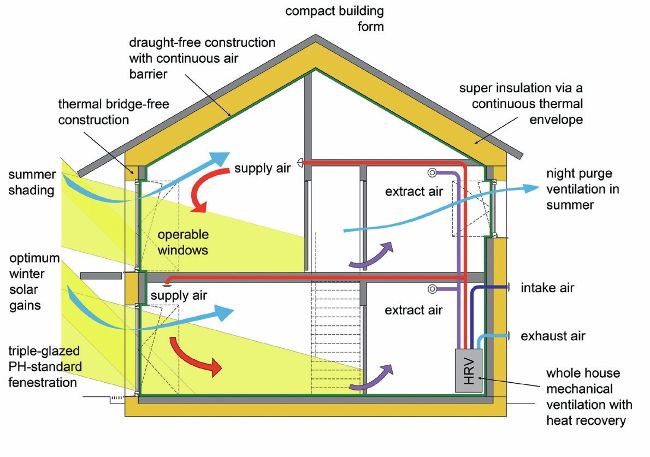
This illustration from the Passivhaus Trust demonstrates the key principles of the low-energy building standard, including super-insulation and a continuous airtightness barrier
One of the keys to realising a low-energy self build is focusing on the thermal envelope – the insulating shell that controls heat, air and moisture movement between indoors and out. It comprises the walls, roof, floor, windows and doors. A well-designed envelope will reduce heat loss, slash bills and cut carbon emissions, but it’s about more than just packing in insulation. Factors such as airtightness, thermal bridging and thermal mass all play crucial roles in achieving comfort, efficiency and durability.
Where to start
The house shell is critical, but before you expend too much energy worrying about how to get it right, it’s worth knowing that simply working to Building Regulations will already put you on the path to a pretty efficient home. The 2022 updates to Part L tightened rules on fabric performance, airtightness and thermal bridging – helping new homes cut carbon emissions by around 30%. The Future Homes Standard, expected from 2027, will push standards further, though we’re not expecting a revolution on U-values or airtightness.
So, there’s scope to go beyond the basics. Many self builders aim for homes with consistent comfort, excellent air quality and very low running costs. How far you go depends on your budget and ambitions. For instance, you could aim for the Passivhaus standard, which sets strict limits on airtightness (under 0.6 air changes per hour at 50 Pascals) and heating/cooling demand (both of which must be under 15 kilowatt-hours per m2 per year).