RAISING HELL
RUN-DMC
MICHAEL LEONARD
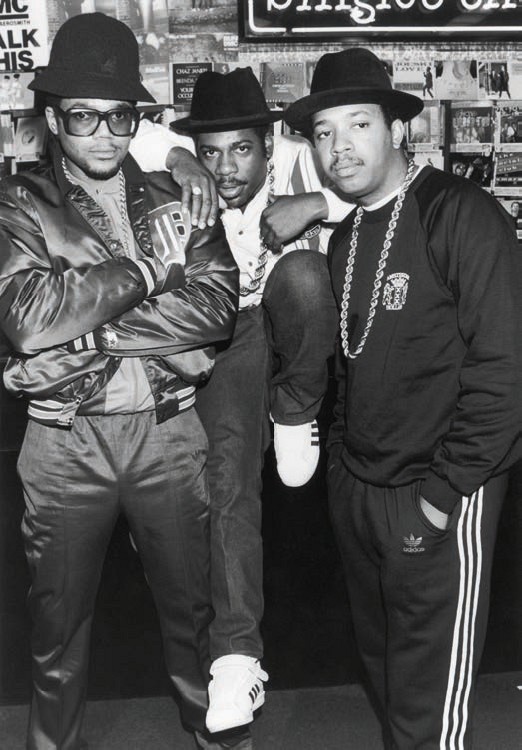
From left: Darryl ‘DMC’ McDaniels, Jason ‘Jam- Master Jay’ Mizell and Joseph ‘Run’ Simmons
© Getty Images
The 1980s was the decade hip-hop went imperial. And if there was one group that were self-declared Kings, it was Run-DMC. The Queens, NYC, trio were already on a fast-rising trajectory by 1986. Their eponymous debut (1984) and King Of Rock LP the following year had both proved solid performers with their heartland African-American audience – the second album was eventually the first hip-hop LP to achieve Platinum status: just as importantly, the singles Rock Box and King Of Rock brought squalling metal guitars (courtesy of sessioneer Eddie Martinez) to nascent hip-hop. An appearance in the 1985 hip-hop movie Krush Groove and being the only rappers to appear at Live Aid in 1985, even if only allowed two tracks, elevated their fame further.
Yet, DJ ‘Jam Master’ Jay later argued they knew that King Of Rock “wasn’t the best we could do.” Although Run-DMC were now more visible, King Of Rock initially didn’t sell much more than their debut. All the first three LPs were on the Profile label, but for this third, Run-DMC turned back to their manager – and Run’s older brother – Russell Simmons who had founded the Def Jam label with Rick Rubin in 1983.
“ THE HIP-HOP RECORDS THAT WERE COMING OUT WERE REALLY LIKE DISCO OR R&B, BUT WITH A PERSON RAPPING ON IT” RICK RUBIN
Russell Simmons and Rick Rubin were an odd couple: Russell had been involved in rap since the early 80s, promoting the likes of Kurtis Blow (and often bringing home tapes of live sets by KB for younger Joseph to practise over. Run later appeared onstage with Blow). Russell Simmons, though, very much had a business brain. In contrast, Rick Rubin was a university student with an equal interest in rock and rap: Rick’s one-time punk band, Hose, had even toured with Meat Puppets and Hüsker Dü. A rudimentary guitarist but no studio wizard back then, Rubin may best be described as an “enabler”. In Def Jam’s early days, the label’s mailing address was Rubin’s NYU dorm.
For Run-DMC, it was his production on LL Cool J’s 1985 LP Radio that turned the group’s heads. LL’s minimalistic sound was credited as “reduced by Rick Rubin” on the label.
“The hip-hop records that were coming out at the time were really like disco or R&B, but with a person rapping on it instead of a girl singing on it,” Rubin later told The AV Club. “I guess what I set out to do as a fan was to make records that sounded like what I liked about going to a hip-hop club, and trying to document that scene.”
THE PLAYERS
JOSEPH ‘RUN’ SIMMONS
Born in 1964, Joseph Simmons is the youngest of three brothers (the eldest being Russell, nearly six years his senior). Run was far from the street rat that his image sometimes portrayed: the Simmons family was pretty middle class. It was only when It’s Like That (the 1983 original, not 1997’s Jason Nevins remix)/Sucker MCs was an underground hit, that Run dropped out of LaGuardia Community College, where he was studying mortuary science. He later pioneered hip-hop reality show Run’s House and is now known as The Rev Run: he truly is an ordained minister in the Pentecostal tradition.