CLASSIC ALBUM
WARM LEATHERETTE
FELIX ROWE
FOR HER FOURTH STUDIO ALBUM, THE INIMITABLE DIVA TOOK AN ABRUPT STYLISTIC ABOUT-TURN WITH THE COMPASS POINT ALL STARS THAT SAW HER MOVE AWAY FROM DISCO AND EMBRACE HER JAMAICAN HERITAGE TO STUNNING EFFECT
GRACE JONES
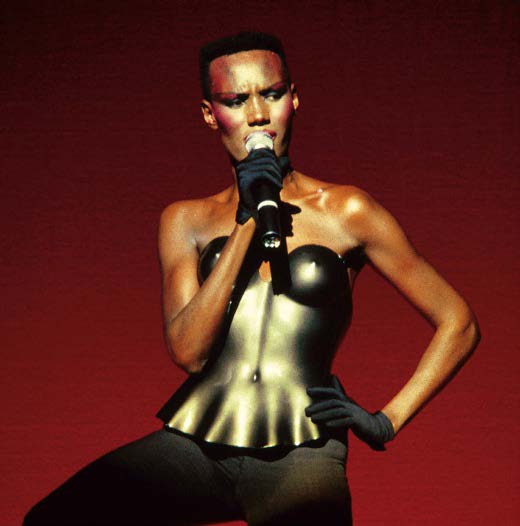
Grace Jones on stage in her Issey Miyakedesigned bronzecoloured breastplate
© Getty
The turn of the 80s marked a distinct shift in gear for Grace Jones, from New York disco diva to laidback rude - girl. No-one could have predicted this phenomenal about-turn, except perhaps her label boss, Island Records’ Chris Blackwell.
If you can get the measure of someone simply by perusing their record collection, then by the same token you can gauge much about an artist from the songs they cover. In the case of a young Grace Jones it was t ypical diva staples, from Edith Piaf’s La Vie En Rose to glitz y Broadway showtunes that were selected to showcase her larger-than-life stage persona. Bold, though dare we say, somewhat hackneyed choices to represent the fledgling star, even when given a state - of-the - art disco makeover.
So, what can we gauge from the lead track chosen to relaunch her into the next decade? A cult, underground B -side by then- obscure English proto -industrial electro act, The Normal (AKA Mute Records supremo Daniel Miller). Warm Leatherette was inspired by dystopian satirist JG Ballard’s Crash novel, whose central theme is “car- crash sexual fetishism”, and according to a contemporar y review from The New York Times: “Handsdown, the most repulsive book I’ve yet to come across.”
Blackwell, would certainly have been forgiven for choking on his morning coffee. On the contrar y, he didn’t just approve this incendiar y venture. He was riding shotgun.
Warm Leatherette is, without doubt, the most important record in Jones’ long and colourful career. This was her pivot album – the artistic repositioning that hailed her transition from fading disco also -ran to for wardthinking, thoroughly modern, Jamaican superstar. Released at the turn of the 80s, it set her up to flourish in the decade, both in the charts and, ultimately, on the big screen. This was achieved by forging a new sound and angular image to match – clearly centred on her Caribbean heritage, while absorbing a range of influences into its deliciously appealing melting pot.
UNTAPPED POTENTIAL
By the end of the 70s, Jones had achieved moderate success with an impressively prolific three studio albums in as many years, helmed by pioneering disco producer Tom Moulton. Yet with disco swiftly falling out of fashion, the scene that launched her was now becoming an artistic albatross. Commercially, too, Jones’ career was stalling at best; at worst, it was on a downward trajectory.
WARM LEATHERETTE IS THE MOST IMPORTANT RECORD IN JONES’ LONG AND COLOURFUL CAREER – FORGING A NEW SOUND AND ANGULAR IMAGE TO MATCH
Blackwell resisted the urge to cut his losses. Rather than sweeping the unprofitable artist off the Island Records roster, he did the opposite, making her a key figure in his label’s new strategy. Blackwell obviously knew Jones had untapped potential, and his pet project – a group that would later become known as the Compass Point All Stars – provided the perfect vehicle in which to unleash it.