METAL GODS
There’ve been ups, there’ve been downs, and after 50-plus years they’re still very much around. We spoke to all current members about life in, and out of, one of the greatest metal bands of them all: Judas Priest.
Words: Dave Everley
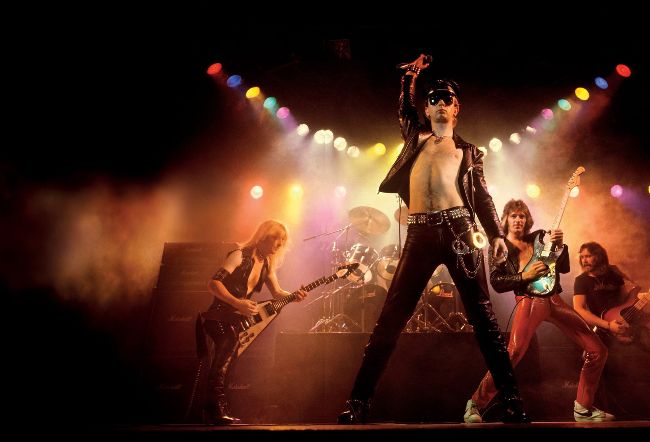
Priest at the shoot for 1979’s Unleashed In The
East album cover.
FIN COSTELLO / GETTY
There’s a cactus in the yard of Rob Halford’s home in Phoenix, Arizona that looks like it’s throwing the horns. It makes frequent appearances in the Judas Priest frontman’s Instagram feed, itself one of the most joyous and life-affirming things on the internet.
The 69-year-old does social media like few other rock stars of his vintage. Recent pictures of him posing in spiked, diamante-encrusted high-heeled boots appear alongside classic photos of a young Halford wearing a period-piece late-70s tracksuit and leaning against an old 12-speed racer outside his old house in Walsall. Inevitably there are shots of cats too. Lots of shots of cats.
Anyway, back to the cactus. It’s been in Halford’s yard since he moved to Phoenix from the West Midlands in 1986. Back then it was a common-orgarden desert shrub, proud and erect if not yet fully metalised. But over the decades it has gradually sprouted a pair of distinct digits a foot or two apart pointing directly heavenwards.
“They’re my Percy Thrower heavy metal fingers,” Halfords says, undoubtedly the only heavy metal singer who would dream of referencing a long-time deceased British TV gardener. “That cactus has grown incrementally into that shape. I guess that’s the effect I have –I turn everything into metal.”
Halford and his bandmates have been turning everything they touch to metal for 50 years now. Led Zeppelin and Black Sabbath laid the foundations for the genre, but it was Priest who reshaped it in their own image – everyone from Metallica to Mötley Crüe bears their musical DNA, while anyone who has stood in front of a camera or walked on stage encased in leather, studs or a combination of both has got it straight from the Judas Priest playbook.
The band are marking their Golden Jubilee with a series of dates in the second half of this year, including a headlining appearance at the UK’s Bloodstock Festival. There’s also the small matter of recording a follow-up to 2018’s stellar Firepower album although Halford is under strict orders not to give anything away.
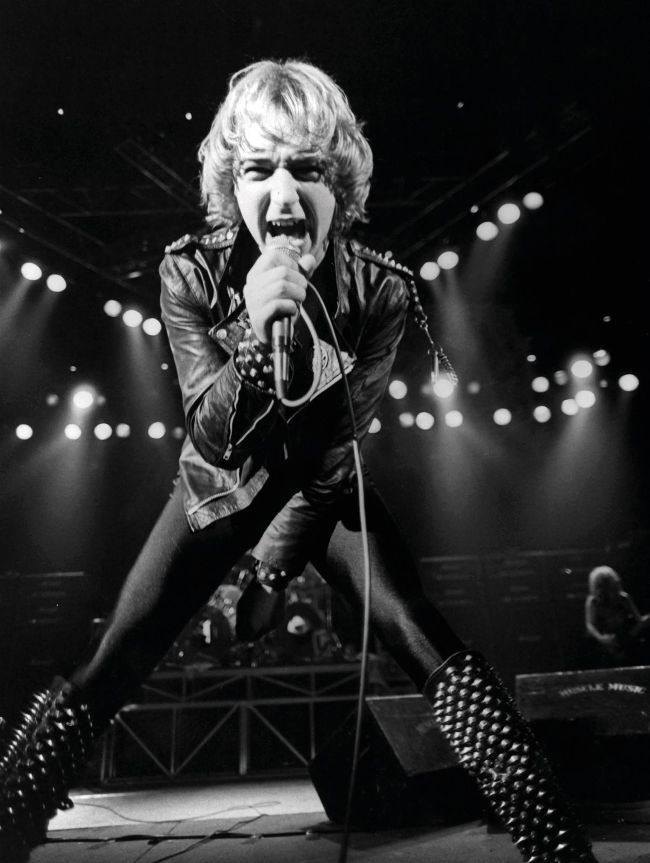
“Heavy metaaal!” Halford on stage and with his wheels of steel in 1980, and today at home in Phoenix, Arizona.
ROSS HALFIN x2; GETTY x1
But there’s plenty to talk about even without that, chiefly Priest’s none-more-epic 50-year journey. “We were just so full of adventure,” says Halford, speaking over Zoom from the house he shares with his partner of 30 years, Thomas Pence. “But you never really grow up in a band, you’re just having a laugh. And you’ve got to be able to laugh, because you’re about to go through some life-changing experiences, for good and bad.”
Before Judas Priest, there was Judas Priest. That Priest were kicking around Birmingham in the late 60s, an entirely different entity to the one that followed. When bassist Ian Hill and guitarist KK Downing brought in singer Al Atkins from the original Judas Priest to join their new band, uninspiringly christened Freight, he brought the name with him. But it was only when Hill began dating Halford’s sister and heard him singing that the pieces fell into place. “Ian says it was Ella Fitzgerald, Ken [KK] said it was Doris Day,” says Halford. “I can’t remember what it was, but it definitely fucking wasn’t Doris Day.”
Your dad worked at the local steelworks. Was there ever any chance of you following him and going to work there too?
I think there was a very good chance. That’s what lads did in the West Midlands – they went to work where their dad worked. I went to my dad’s place a few times as a younger lad. I saw enough of it to think: “This is I where I’d end up until I retire and they give me a gold watch.” That’s a motivation for a lot of musicians – you don’t want to end up where your dad’s working.
Were you a show-off as a kid?
Yeah, I think we all are, us singers. Anything for attention. I remember once on a Sunday afternoon when I was five or six, I went into my grandmother’s handbag and found her make-up and did myself up as a drag queen. I remember coming in and my grandma going: “Oh, it’s a nancy-boy!” I was grinning, with the rouge and the eyeliner, looking like Dusty Springfield on crack. It was hysterical.
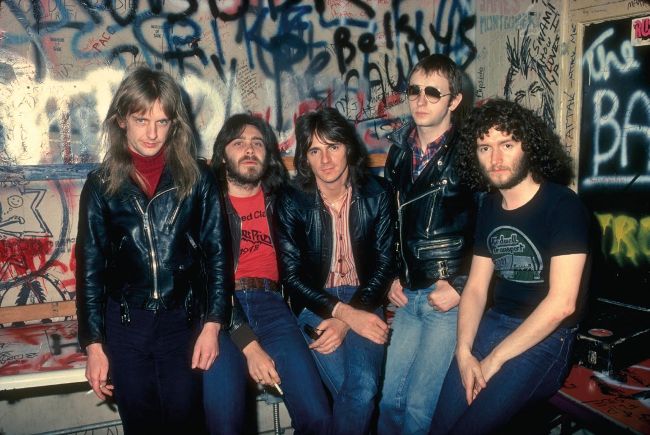
Judas Priest in ’78: (l to r) KK Downing, Ian Hill, Glenn
Tipton, Rob Halford, Les Binks.
“I was grinning, with the rouge and the eyeliner, looking like Dusty Springfield on crack. It was hysterical.”
Rob Halford on childhood days
You spent a few years acting in your late teens. What was the attraction?
I was just enthralled by everything to do with escapism, breaking away from the reality of life. I grew up in a household where the telly or the radio was always on, there was always something going on in the background, whether it was films or music. I was just naturally inquisitive for that kind of life. I still am. I wanted to be a part of it.
You also managed a friend’s adult bookstore for a couple of weeks. What are the upsides of working in a porn shop?
[Laughing] You can have a surreptitious wank when there’s no customers around. No, you learn to read people – you can tell what they’re going to go for as soon as they walk through the door: “He’s going to go for the bondage”; “He’s going to go for the big tits.”
Funnily enough, history repeated itself decades later. I was doing this movie, Spun [in which Halford plays the manager of an adult shop]. I’m in this porn shop in Santa Monica with [co-star] Mickey Rourke, and he goes: “It hasn’t changed much in here.” I go: “What do you mean?” He says: “I used to work here while I was trying to get work in Hollywood.” I said: “Have I got a story to tell you.”
IAN HILL
The bassist has been with Priest from the beginning, through thick and thin. And while he’s enjoyed spending time at home with his family recently, he’s missing being out on the road.
You were there at the beginning. Can you remember the very first Judas Priest gig?
I remember it well. It was Essington Working Men’s Club, just outside of Walsall There were only about twelve people there.
What did you make of Rob Halford the first time you met him?
The first thing I heard was his voice. I was going out with his sister, Sue, and he was still living with their mum and dad. He’s always been an easygoing guy, a pragmatist, a bit like myself.
What was it like being in Judas Priest in those early days?
It was brilliant. We’d load all our gear in the back of the van, then put the mattresses on top of the gear and that’s where we slept. We played pubs and Student Unions and places like The Cavern. You’d be at some Working Men’s Club in the north and they’d be looking over their pints at you, deadpan. Then the committee head would come bumbling on stage halfway through and ask you to read the raffle [laughs].
What did you think when Rob said he was going to ride a motorbike on stage?
We thought it was a bit mad, but it was one of those great ideas. We got in touch with Harley- Davidson and asked if they’d be interested in providing a motorcycle for us. They wouldn’t give us one, but they’d sell us one for a dollar. So that’s what we paid for it -a dollar.
Is it true that you’ve still got the original Harley?
I think it’s the basic frame. It’s got something like twenty-seven miles on it. In the early days they’d let you start the thing up and drive it on. But then the fire marshals got a bit nervous. They said: “You can have it on stage but you can’t have any fuel in it.” So we have to roll it on.
Priest supported Led Zeppelin in San Francisco at the end of your first US the fans.” tour in 1977. What was that like?
We were on at something like ten in the morning, and when we came out there was so much fog that we couldn’t see the audience. As we started to play, the fog began to burn off, and we started to see one row, then another. Then it lifted completely and we were like: “Jesus, look at all these people!”
Priest were playing pretty big gigs of their own within a few years. Did that level of fame mess with your head?
It did to start with. You think: “Christ, all these people have come to see us.” It’s a bit awe-inspiring. But if you do it long enough the jitters go. You’re going out there to do a job.
Priest caused a riot at Madison Square Garden in 1984. What was it like being in the middle of it?
It was surreal. Someone tore the foam out of a seat and threw it on stage, then somebody thought: “That’s a good idea.” Suddenly there were whole seats coming up on stage. It was hilarious. We got banned from playing there.
When were you un-banned?
We haven’t been. But Ken [KK Downing] and Glenn [Tipton] went a few years later to see something or other. One of the stewards nudged them and said: “Thanks for the new seats, lads.”
How did you feel when Priest’s Eat Me Alive ended up on the PMRC’s Filthy Fifteen?
It was nonsense. It was a bunch of ignorant politicians’ wives. They didn’t have the slightest idea about poplar culture – it was all evil and must be eliminated. Same with the court case we went through. Subliminal messaging? That was just a trumped-up charge.
Rob had his problems with drugs and booze in the eighties. Did you steer clear of those things?
Not entirely, no. But it was never dangerous with any of us. It never got to the dangerous point. Even then, I was stone-cold sober when I went on stage. I had too much respect for the fans.
How were the 1990s for you?
Turbulent. Rob wanted to go and do a solo album, which ended up evolving into a solo career. If things had been handled differently it could have been very different. But we were determined to get through it and prove people wrong.
Had you bumped into Rob before he rejoined?
He didn’t know it, but I went to see him play at the NEC in Birmingham. They were good, too. And then Ken and myself were at Rob’s mum and dad’s golden wedding anniversary. That was the big ice-melter. We saw each other and hugged. And the next thing you know he was back with us. Even Ripper knew it was a good idea.
Do you care that Judas Priest aren’t in the Rock And Roll Hall Of Fame?
To be honest, no. These things come along and they’re great, it means you’re being recognised by your peers. But when you don’t get them you move on, it doesn’t make any difference.
How many more Priest albums do you have in you?
There is one in the pipeline at the moment. These days you have to take things one step at a time. We’ll carry on as long as we can give quality performances. If the quality starts to fall off, there’s not much point going on.
You must have thought about the day when Judas Priest will no longer be part of your life.
I’ve enjoyed the last year, being with my family, pottering in the garage, mowing the lawns. But I am terribly missing not being out on the road. So that’ll be a sweet and sour moment when it does come.