Hotshots
Winning entries from the Prince Albert II of Monaco Foundation’s Environmental Photography Award 2024
IGPOTY/June Sharpe
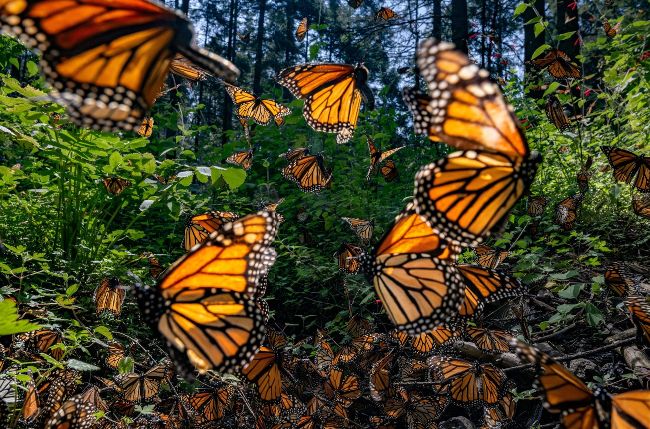
WINNER: Into the Forest
‘Explosion of Monarchs’
Jaime Rojo
“As the days get longer and warmer in the oyamel fir forests, the first signs of spring bring with them a remarkable increase in activity at the Monarch Butterflies Biosphere Reserve in Michoacán, Mexico.
“The monarch butterflies have stored enough fat before they start their migration, so the majority of them won’t need to eat much when they are overwintering in Mexico. However, they do need to drink, so water or dew must be available to them because they can be pretty active in the heat of the day. To quench their thirst, thousands of butterflies swarm to the ground near small streams, where they sip liquid and vital minerals from the wet soil – a behaviour called puddling.
“Climate change and the water-thirsty avocado plantations that encroach on the reserve are changing the delicate moisture balance on which these forests –and the monarch butterflies –depend.”
Soumya Ranjan Bhattacharyya / 2024 Environmental Photography Award
RUNNER-UP: Into the Forest
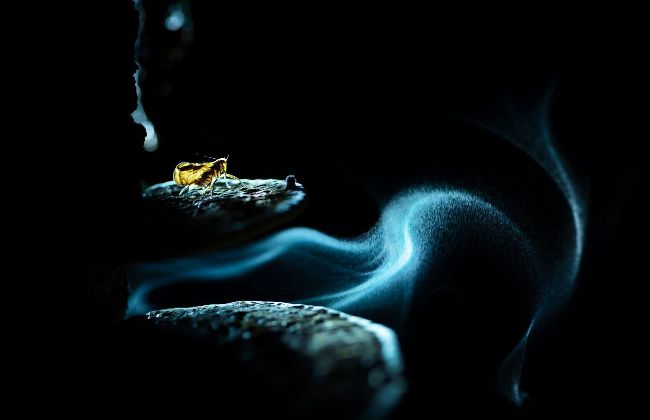
‘Galaxies at my Feet’ Soumya Ranjan Bhattacharyya
“During the monsoon season of 2022, I visited the moist deciduous forest on the outskirts of the Bhagwan Mahavir Wildlife Sanctuary in Goa, India. There, I was able to observe the spore dispersal of bracket fungi, also known as shelf or polypore fungi, which grow in tiers on the bark of large trees. As I was photographing a group of these fungi at night, a yellow planthopper came to sit on one of them, amidst the volutes created by the vigorous dispersal of their spores. I backlit the scene with a flashlight to bring out all the magic of the forest, but as the sporing became more intense, the insect flew away. The Western Ghats mountain range, where the wildlife sanctuary is located, covers an area of 140,000 km² and is one of the world’s most important biodiversity hotspots. It is home to a large proportion of India’s plant and animal species, many of which are endemic.”