Do It Yourself
The growth of organised fandom throughout the late 1970s and early 80s led to an explosion in self-published magazines.
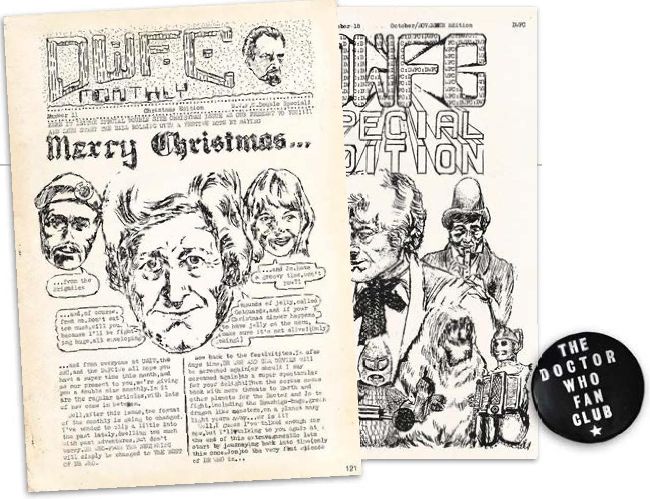
DWFC
Monthly
number 11 (1972), DWFC Special Edition number 18 (1973) and a club badge.
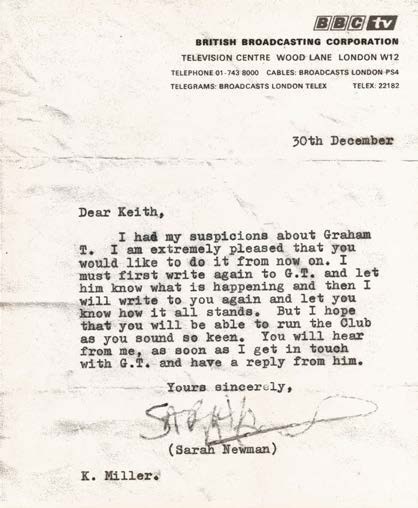
A letter from Doctor Who production secretary Sarah Newman to DWFC organiser Keith Miller.
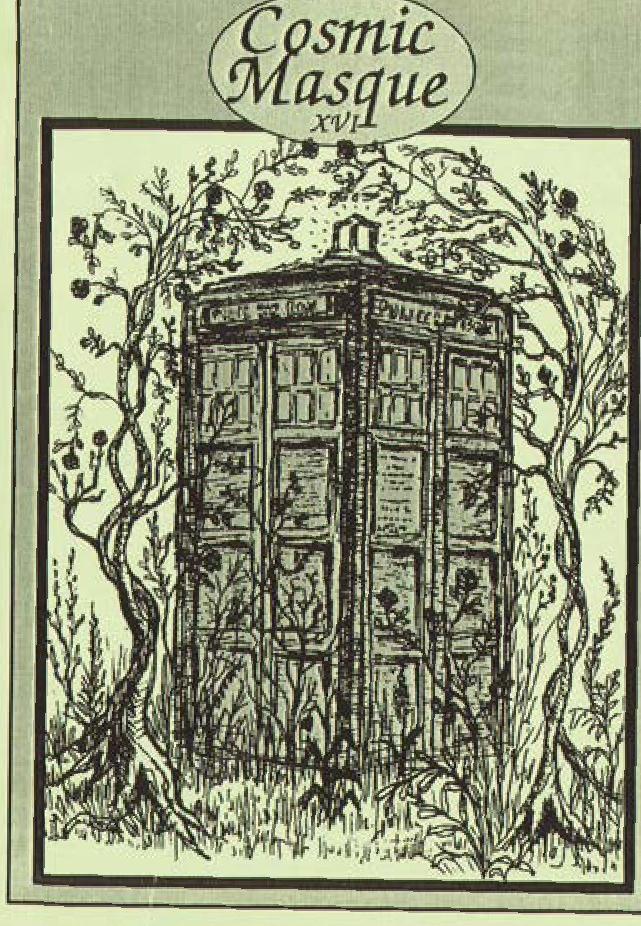
Cosmic
Masque
issue XVI (1991).
Decades before social media gave Doctor Who fans a voice, opinions and enthusiasm were shared via printed fan magazines or ‘fanzines’, made for love not money. Schoolkids and students grappled with cheap stationery and rudimentary printing to express their affection for the show – and sometimes their dissatisfaction.
The first BBC-recognised Doctor Who Fan Club, run by Stoke-on-Trent schoolboys Larry Leake and Philip John Oliver from the mid-1960s, produced brief but regular newsletters. From 1969, their successor, Derbyshire’s Graham Tattersall, produced a more ambitious fanzine, simply titled Doctor Who. Comprising a dozen foolscap sheets of stories and quizzes, it was made with a hand-cranked workplace duplicator. Tattersall was himself succeeded, in 1972, by a 13-year-old from Edinburgh called Keith Miller, whose DWFC Monthly (later DWFC Mag) was packed with news, reviews, archive synopses and studio reports. Miller was supported by BBC production secretary Sarah Newman, who ran off copies on the Doctor Who production office’s duplicator.
In 1975 Miller was overwhelmed by more than a thousand responses to an advert placed in World of Horror magazine. He tried to enlist the assistance of club members Jan Vincent-Rudzki and Gordon Blows, but Vincent-Rudzki started his own club at University of London’s Westfield College. This was the Doctor Who Appreciation Society.
Comics fan Andrew Johnson had produced the A5 fanzine TARDIS in April 1975, with Blows and Vincent-Rudzki quickly becoming involved. When Johnson’s enthusiasm waned, Blows took over from issue 3. By the summer of 1976 it was the official DWAS fanzine, selling 350 copies an issue. From this point, DWAS publishing expanded rapidly. Blows and Keith Barnfather devised the society newsletter Celestial Toyroom, while information officer Jeremy Bentham worked alongside art department head Stuart Glazebrook to produce a run of special issues, beginning with Cybermen/Daleks Autumn Extra in 1976. Barnfather then oversaw the first of many DWAS Yearbooks from early 1977, and in 1978 Blows devised the fiction-zine Cosmic Masque.