Terrible Things
Why are monsters so central to Doctor Who’s mythology? And why do we love to hate them so much?
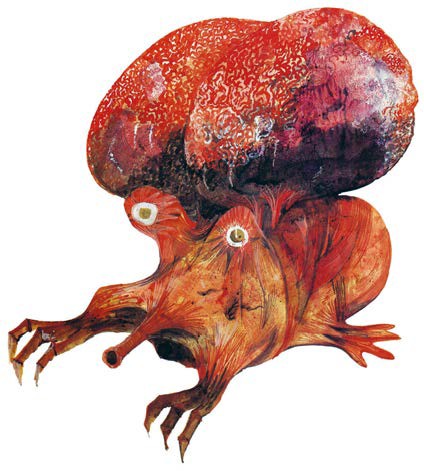
The Dalek mutant, only hinted at on screen in the first Dalek story, realised in an illustration by Dalek designer Raymond Cusick.
“You is the role you seemed determined to play.So it seems I must play mine. The man who stops the monsters.”
As mission statements go, this declaration by the Doctor (Peter Capaldi) in 2014’s Flatline feels right on the money. Because Doctor Who without monsters is like fish without chips, Ant without Dec, Jago without Litefoot.
But why? If Doctor Who is a science-fiction series (and we do mean if – see pages 8-11 for more on that conundrum), then rockets, ray guns and spacesuits would surely be more obvious touchstones? Maybe that’s why former showrunner Steven Moffat once claimed that Doctor Who “isn’t set in space – it’s set under your bed”. It’s the show you’re supposed to watch from behind the sofa, after all.
For all of this, we can thank a race of irradiated mutants from the planet Skaro. During the series’ early development, the show’s co-creator Sydney Newman was famously insistent it should feature no BEMs (bug-eyed monsters). But the runaway success of the Daleks rapidly eclipsed everything else about the show – including Doctor Who himself – at which point it became clear that the children of Britain weren’t prepared to sit through many more history lessons about Marco Polo or the French Revolution.
By the time the Second Doctor was in full sail, no one was bothering to pretend that it wasn’t all about the monsters – the more bug-eyed and beastly the better. “There are some corners of the universe that have bred the most terrible things,” our hero intoned, gravely, in The Moonbase (1967). “Things that act against everything we believe in. They must be fought.” And this, effectively, has been the show’s animating force ever since.