CLOSING THE LOOP
Lemnis Gate looks to the past, present and future of the firstperson shooter
By Alex Spencer
What can you achieve within 25 seconds, really? In multiplayer shooter terms, it might be long enough to land a couple of headshots or (more often, at least in our case) to sprint from a spawn point, trying to rejoin the action before it moves on. In Lemnis Gate, though, 25 seconds is the length of an entire round, the duration of your character’s entire existence. Fortunately, you get more than one shot at it.
Once the countdown hits zero, you simply pick a different character class – ‘operatives’, in Lemnis Gate’s parlance – and play out those same seconds from a fresh perspective. And again, and again, your new actions layered atop everything you did before until there’s a full team of five fighting side by side, all controlled by a single player. So, yes, it’s another example of this season’s must-have gaming accessory, the time loop. But to understand what makes Lemnis Gate such a joyously unusual experience, it’s probably more useful to think of it as a turn-based shooter.
There’s an extra step that needs to be inserted into the version of events above. At the end of each loop, before you start over with your next operative, play passes to your opponent. They study what you made of those 25 seconds, and try to think of a way to undo it. So, say you sent a scout to snatch an objective and run it back to base, scoring the first point of the match. Your opponent might counter with their sniper, catching the scout with a well-aimed headshot to wipe him – and that scored point – off the timeline before he can ever touch the objective. Or perhaps they sneak their engineer to your goal line, awaiting the scout’s return with a freshly planted crop of turrets.
James Anderson, co-founder of Ratloop Games Canada and Lemnis Gate game director, likens it to chess: there’s a limited selection of pieces, with each move a reaction to the current state of play and, ideally, an anticipation of what’s next. “Using your mind is as powerful as using your weapons,” he promises. The idea is to reward a clever idea and careful planning as much as twitch reflexes or time-honed mastery. And, as the studio enters an arena dominated by experienced competition, Ratloop is hoping those same values –a clever idea and careful planning – can level the playing field not just within its game, but in the world outside too.
Game Lemnis Gate
Developer Ratloop Games Canada
Publisher Frontier Foundry
Format PC, PS4, PS5, Xbox One, Xbox Series
Release Summer

Following the action from your drone when you’re not taking your turn is a skill in itself – where should you be focusing your attention? What important details did you miss last time? Could you take out a threat to your own team in your next move, or is there an opportunity to prepare for something your opponent might do?
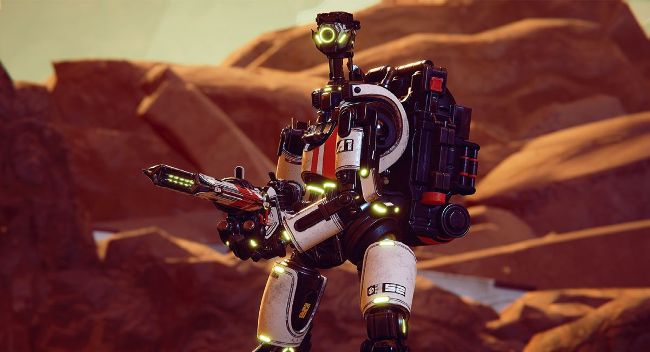
Equal parts Bastion, Pathfinder and Johnny 5, KARL fills the ‘oddly adorable robot’ slot required in hero shooters nowadays. He’s one of seven options, each with a unique weapon and ability, from which you select a team of five
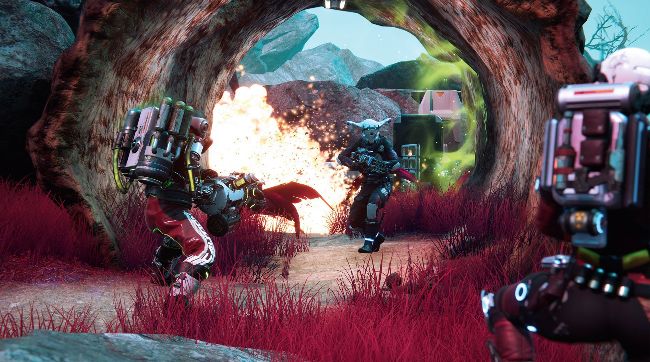
There’s a minute’s grace period between turns, during which the loop can reset over and over to give you a closer look
Lemnis Gate is the second game from Ratloop Games Canada, and the one it has been working towards since the studio was founded in 2017. “We knew this was the idea that was going to help us differentiate ourselves from competitors,” says Vivian Yen, Ratloop’s CEO and producer on Lemnis Gate. The studio’s previous title, Vroom Kaboom –a mix of deckbuilder, tower defence and car combat – was a smaller-scale production, and Yen now positions it as something of a practice run.
Ratloop describes Lemnis Gate as a ‘triple-I’ production, one of those rare games made in the squeezed middle between blockbuster and arthouse. It’s a difficult space for a multiplayer shooter to exist within – as plenty of other developers have discovered of late. Ninja Theory, one of the studios which helped popularise the term with Hellblade, stepped away from development of Bleeding Edge earlier this year after the team shooter/brawler hybrid struggled to find an audience, even with the support of Microsoft behind it. Meanwhile, Disintegration, the first multiplayer shooter from Take Two’s triple-I publishing label Private Division, closed its servers just a few months after launch.
Lemnis Gate is being made by a small team with far fewer resources than most FPS studios have at their disposal. But, as those other games have shown, players don’t set their expectations for an online shooter according to its budget – and Yen is well aware of that. “We’ll be competing against triple-A shooters just because they exist, and it’s the same people who will want to play these games,” she says. “And knowing that, we decided to see where we can best compete.”