CROWD COVER
How social stealth found its people in the world of indie multiplayer
By Jeremy Peel
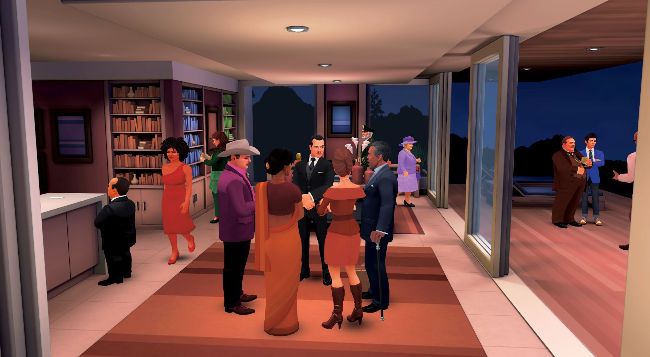
When SpyParty guests are bunched together, sleight of hand can conceal any telltale action from a sniper
Will Wright is certain: “That’s not gonna work.” Maxis is mid-development on Spore, and an engineer named Chris Hecker is describing an ambitious side project. An asymmetrical multiplayer game called SniperParty, its premise is as binary as its title: one player attends a party as a spy, blending into the throng of mannered guests while surreptitiously swapping statues and planting bugs on ambassadors. Meanwhile, a second player with a sniper rifle occupies a roof across the street, with a single task: they must pick out the spy in the crowd and take the shot. But they need to be sure of their target because they have just a single bullet. For the sniper, the game is about reading social cues, spotting a strange gesture or conversation cut short and mentally building the case against a suspect.
It’s a design that tends to quickly woo those who hear about it: easy to grasp, yet dense with possibilities. SimCity creator and industry mentor Wright, however, isn’t on board. “It’s gonna be too easy to tell who the player is,” he concludes. As it turns out, Spore will be a grand lesson for Wright in what works and what doesn’t. But the assessment his game receives gives Hecker pause. “When game design genius Will Wright tells you that your game’s not gonna work, you’re like, ‘Ah, shit,’” he remembers.
Ironically, it was Wright and EA who had enabled Hecker’s experiment in the first place. Hecker negotiated the use of assets from The Sims, Wright’s breakout paean to domesticity, in the 2005 Indie Game Jam. Then in its fourth year – and still a few more away from the indie boom that would be triggered by regular participant Jonathan Blow – the event challenged participating designer-programmers to explore human interaction. “Some of us organisers thought, well, there aren’t a lot of games about normal people,” Hecker says. “People in the world – not space marines.”
IN THESE GAMES, STEALTH HAPPENS IN THE DAYLIGHT, AS TARGETS ATTEMPT TO PULL THE WOOL OVER THEIR PREDATORS’ WATCHING EYES
If that’s true today, it was considerably more so at the time. Entrants had few examples to draw from. But Hecker recalled a previous Indie Jam entry, Thatcher Ulrich’s Dueling Machine, in which a Doom avatar with a single bullet hunted a target player hidden by thousands of sprite pedestrians. “What’s the intimate version of that?” he wondered. Among the selection of NPCs that The Sims could muster, one differently modelled character would be immediately distinguishable. But if that character was physically anonymous, dressed like any other guest, a searcher would have to rely on subtler tells.
“I got a room full of characters walking around,” Hecker says. “They would pause, play a talk animation to each other and then walk away. Really simple – no missions, no nothing. And I put one of them under my control.” He recorded a video and sent it to Wright as a kind of digital Where’s Wally? test. It was a success. Wright couldn’t pick out the player.