Masterclass
MIX DON’T MATCH!
Looking at railways in detail
Variety is the spice of life, says Chris Leigh, so why do modellers want matching rakes of carriages and wagons? Let’s explore some options.
T hroughoutmy 60-plus years in the model railway hobby, one of the recurrent controversies has been over the colour of models. Leaving aside the variation in how different people see different shades of the same colour, there can be lots of grumbles when a manufacturer changes the shade of a ‘standard’ colour.
Some folk even think that colours such as BR locomotive green should match across all the different manufacturers, despite the fact that colours have to be adapted to suit models and that not all manufacturers use the same paint suppliers. Simply using ‘full size’ paint on models which are 1/76th full size does not work. The colour will always look too dark. It needs to be ‘interpreted’ and that interpretation differs from one person to the next, and from one manufacturer to another.
With different people specifying their interpretation to different paint manufacturers, it’s no wonder that there’s variation. Some modellers are more than a little reluctant to accept that fact. We can become almost compulsive about colours and many modellers seem to believe that it is crucially important to have matching rakes of stock for passenger trains, block freight trains and so on.
I would argue that having matching rakes of stock is sacrificing realism for uniformity
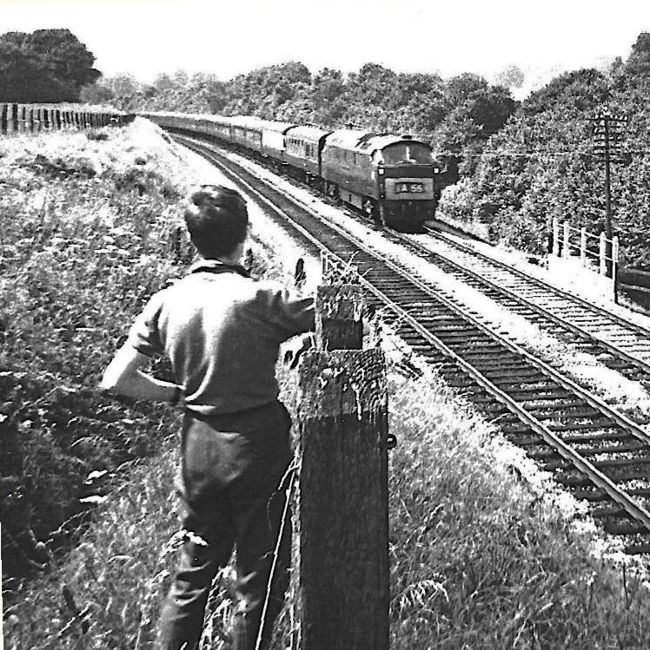
The writer, as a teenager, watches a ‘Western’ diesel-hydraulic climbing the bank to cross the Kennet and Avon canal at Savernake with an Up express, the second vehicle of which is a GWR ‘special saloon’ in chocolate and cream.
ROGER LEIGH
Fair enough, if that’s the neat, tidy, matching look that you want to create, but I would argue that you are sacrificing realism for uniformity. Since the implementation of British Rail’s Corporate Image in 1964, the railway has become much more concerned with how things look and modern business practice stresses the importance of ‘brand identity’.
It wasn’t always so.
On the real railway, prior to the late 1960s, full matching rakes of vehicles were the exception rather than the rule. Even on prestige, named trains, a set of new, matching coaches would not last intact for long. For instance, a failed vehicle would need to be substituted with whatever was available. I recall, when I was working for Ian Allan, that we organised a railtour to mark the last through passenger working from Paddington to Birkenhead. It was at the time when the BR Corporate Image was being introduced and carriages were being transformed from lined maroon to Rail blue and grey. Such was the demand for tickets that we had to run two trains, using ‘Castle’ 4 ‐ 6‐0s Nos. 4079
Pendennis
Castle
and 7029
Clun
Castle.
The two trains, ‘The Zulu’ and ‘The Birkenhead Flier’, were identical formations in terms of the types of coach and the seating plan. However, externally, one train had the majority of coaches in maroon, with three, if I recall correctly, in blue and grey. The other train was predominantly blue and grey, with three coaches in maroon. Swapping the coaches to obtain two uniform-coloured rakes was not possible because the coaches were different types featuring different seating capacity and layout. It would have upset the standardised seating plan.