Masterclass
CONNECT FOUR
Looking at railways in detail
The Grouping was one of the most dramatic changes ever seen on Britain’s railways. Nick Brodrick recounts how it came about and offers some pointers for modelling the fascinating changeover period of the 1920s.
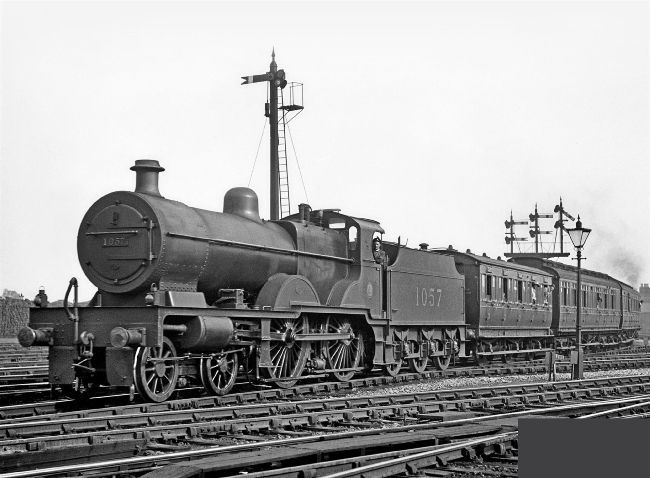
A direct result of Henry Fowler’s ‘Small Engine Policy’ was the construction of more Midland
Compounds in the years immediately following the Grouping. May 1924-built No. 1057 approaches Derby Midland on August 8 1925.
The leading vehicle is appreciably comparable to Hattons’ ‘Genesis’ six-wheeled carriages.
T.G. HEPBURN/RAIL ARCHIVE STEPHENSON
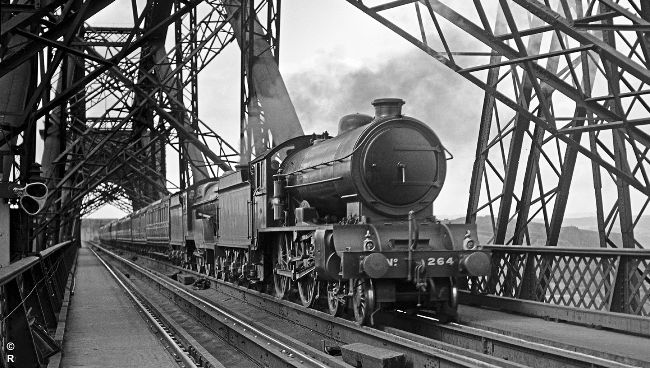
Double-heading of 4‐4‐0s on former North British Railway metals was common. Here, ‘Scottish Director’ (‘D11’) No. 6395
Ellen Douglas
leads one of its LNER successor ‘D49s’, No. 264
Stirlingshire,
across the Forth Bridge with a heavy express to Edinburgh Waverley in June 1929.
G.R. GRIGS/RAIL ARCHIVE STEPHENSON
It might be easy to view the pre-Grouping era as the last great time of flamboyancy and pomp on Britain’s railways.
The reality is more nuanced. As midnight fell on December 31 1922, the end of the 120-plus individual companies was a culmination of a downward spiral faced since the turn of the century, and hastened by the ruin of the First World War.
A blueprint for radical change had existed since 1912 following the first threat of war, triggered by the Agadir Crisis in north Africa. That jolted the government to establish a shadow Railway Executive Committee (REC). In the event of war, the REC would effectively take control of the railway companies to enable effective mobilisation of troops and equipment.
This ultimately happened on August 4 1914, the day that Britain declared war on Germany. With that the railways were effectively nationalised.
They did retain individual branding, but austerity measures were inevitably accompanied by the desaturation of colour from its stock. Take the South Eastern & Chatham Railway, which had already begun to simplify its ostentatious lined green liveries. After 1914, they were treated to the ignominy of battleship grey.
Of greater consequence was the recognition that operating under more strategic operations conditions exposed many of the inefficiencies and duplications that had previously threatened many of the ‘123’ with insolvency; aggressive competition between rivals was matched with excessive overspend and simultaneous harm to passenger services.
The end of hostilities in November 1918 offered respite, but heavy-duty lorries became surplus to requirements, leading to a rise in competition for goods deliveries.
The role of the REC remained after the war while a new solution was investigated by a Parliamentary Select Committee on Transport. Any likelihood of nationalisation was a non-starter following the 1917 Russian Revolution. A shift to a nationalised railway might have been seen to be promoting socialist management and might have also encouraged detrimental political interference.