EXPERT MODELLERS SHOW YOU HOW
HOW TO PLAN & SET UP A MODEL SCENE
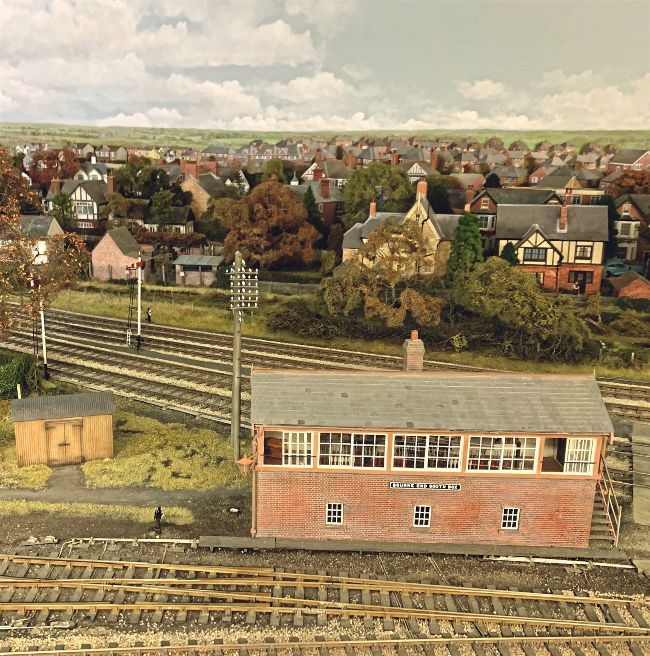
An effective backdrop can make or break a layout. As Paul Bambrick explains, it’s often best to plan this element at an early stage, as it may need to tally with scenic contours and may even dictate the size and shape of your baseboards.
PHOTOGRAPHY: PAUL BAMBRICK
These are a few of the basic steps that I take when starting out with a scenic layout or diorama. It’s just a sequence of safeguards that might help to keep a project out of trouble at a later stage, so if you are planning a scenic layout, I hope they come in handy.
To get the best from your scenic work, it’s going to help if we have a quick look at a few aspects of human perception, so we can understand best how it may benefit your project.
WHAT’S OUR PERCEPTION?
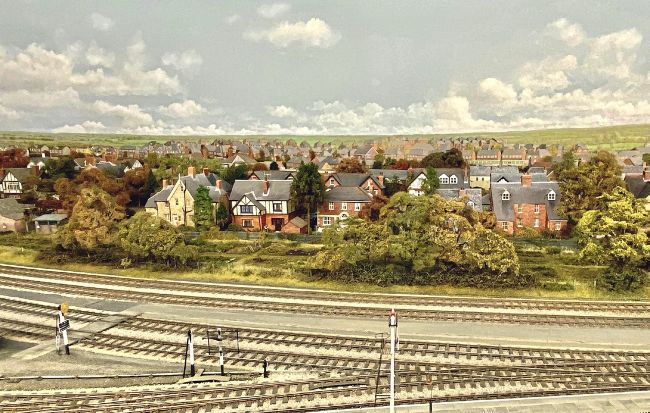
When it comes to the surroundings of a railway model, we’re really after a convincing illusion of the locality. Sometimes it will need to be an accurate and prototypical ‘window into the past’, (like this example), but it might also be a more generic depiction to suit an imaginary railway. In either case, there are number of methods that we can employ to persuade the viewer into perceiving a modelled landscape as a real place.
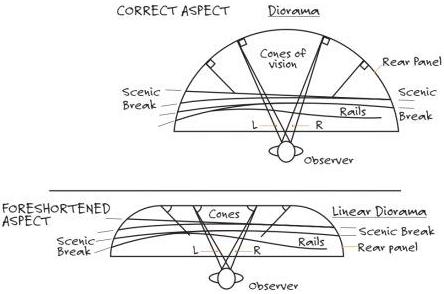
The ideal configuration for any diorama backscene is a semicircular arrangement, replicating our natural survey of the surroundings, but with the typical linear nature of railway models, it’s often the case that there’s insufficient room for this, and a linear panel is required instead, running parallel to the railway itself. This can lead to one of the first problems when doing a backscene, which is a vertical foreshortening of the image. The effect can be seen in the sketch, where the semi-circular diorama (upper) produces correct right angles, but the linear arrangement (lower) produces more acute viewing angles.
When we survey a real landscape, we see an entire panorama as we rotate through 360 degrees of vision. We can look up at the sky far above us, or down to the surface close by. With a linear subject such as a railway line, it’s normal to observe it from quite nearby because it’s the main focus of our interest. Only a directional left to right survey of the scene is required to see the trains in their habitat, so we can obscure anything we don’t need to see as unnecessary areas of the overall ‘picture’.