DANGER IN THE PAST
Sat in a house he hadn’t entered for 40 years, pondering questions that cut to the very meaning of his art, conversations with the writer and musician WARREN ZANES led BRUCE SPRINGSTEEN down perilous paths- back to his post-River crisis, his childhood, and beyond, and formed the core of Zanes’ illuminating new book about Nebraska. As the singer explained, “I needed to know that I could go back and be nobody.”
PLUS!
E Street on fire! Bruce live in 2023 by KEITH CAMERON. Springsteen’s landmark 1973 by DAVID SANCIOUS.
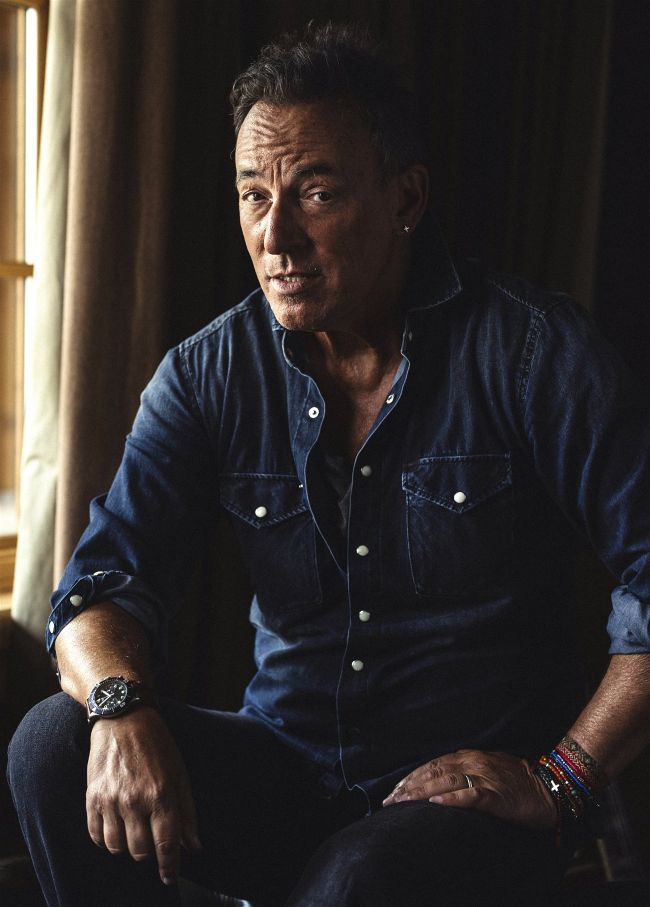
If you have ghosts: Bruce Springsteen at home in Colts Neck, New Jersey.
Portrait by BRYAN DERBALLA.
JUST A FEW WEEKS AFTER COMPLETING THE MANUSCRIPT FOR my book about Nebraska, I walked with Bruce Springsteen into the Colts Neck, NJ home where he originally recorded the album.
In the week before, Springsteen’s manager, Jon Landau, had read what I sent him, passed it along to Springsteen, and I was given the opportunity to discuss the book with both men. In a follow-up e-mail, Springsteen asked me how he could help. “The house,” I wrote, “I can’t find it.”
Some 40 years earlier, Springsteen had rented that ranch house in the midst of the tour supporting The River. It was the spring of 2022 when he invited me back there. “If you want to see the room,” he told me by phone, just days after our e-mail exchange, “the owner said it’d be OK. We just have to find a time when the renters aren’t home, and we can go out there together.”
We drove over in Springsteen’s 1970 El Camino, a gift from his wife, Patti. While the outside of the house has changed, with a storey added and the footprint of the place enlarged, the bedroom where he made Nebraska remains basically the same, right down to the orange shag carpets.
To walk into that room is stirring. To walk in there with him?
For a moment we stood quietly. The room had some kind of vibration, or so it seemed to me. It felt like there was some Nebraska in the walls and floors. Or maybe it was the effect of finally getting to see a place that I’d tried so hard to visualise and for so long.
Springsteen broke the initial silence. “The bed was right there, the headboard at that side wall,” he explained. “In that corner of the room there was a round, antique table where we put the recording machine. [Roadie] Mike [Batlan] was there. I had a chair at the end of the bed, with the mikes in front of me. That was it. That’s how we made the record.”
I took it all in with him, then he handed me his phone and said, “Can you grab a picture of me in here?” So I took a photograph of Bruce Springsteen in a room where the characters of Nebraska had spilled out, in trouble, lost, running, asking him to follow them.
WHEN DID MY OWN RELATIONSHIP WITH Nebraska begin? Probably 1982, when the LP came out, when I got my hands on it and it started working on me. I was beginning my senior year at Phillips Andover Academy in Massachusetts. By that time, the school had asked, twice and by official letter, that I not return. Despite myself, I graduated. And on graduation day I had my first rehearsal with the band I was joining, The Del Fuegos. We played CBGB’s a few weeks later.
It was a year and some months later when Springsteen would get on-stage with us, at the Rhinoceros Club in Greensboro,
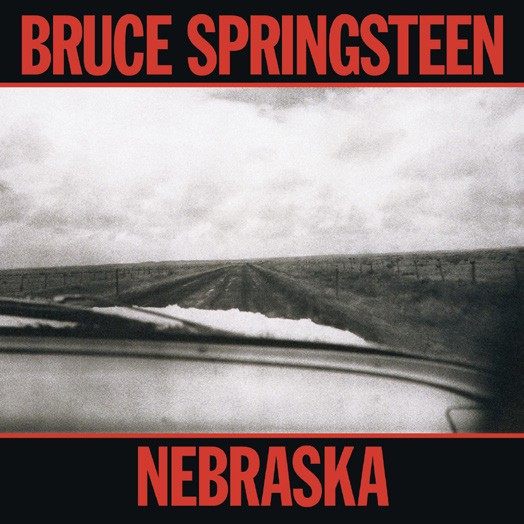
Getty, Lynn Goldsmith/Getty
North Carolina, between dates on the Born In The USA tour. We’d played Hang On Sloopy and Stand By Me. When we got up there with him, I turned my amp down to zero. Not three or four, zero. I didn’t want to miss anything simply because I was playing guitar – better to just hold one. And I remember looking at Springsteen, thinking, “That’s the guy who made Nebraska.”
By 1985 Nebraska was deep in me, where it would remain. From there I’d go in and out of a few bands, a few universities, a few jobs, a few marriages, but that particular recording would stay with me, a thing I reached for, often when I was in trouble myself. I thought a lot about the songs, why they affected me as they did, but if there was one question that lingered, it was this: Why would an artist who just scored his first Number 1 album and first Top 10 single release a record like that? From one angle it looked like self-sabotage. It was so at odds with the marketplace, with the early MTV era, with the sounds of the moment. Why was he compelled to do it? I felt it was a question that hadn’t yet been answered, not fully.
Without Springsteen himself, that question was going to be hard to answer. Nebraska’s recording situation was solitary, with Springsteen either alone in the room or there with Mike Batlan. There was little to nothing in the way of mediation – it went from Springsteen’s mind to the tape. So to understand its emergence, its tangled origins, Springsteen’s state at the time, I needed him.
As he would tell me: “I was interested in making myself as invisible as possible. I just wanted to be another ghost. On that particular record. It spoke to some need in me. Some roaring need. That might have been a result of having had the kind of success that I had.
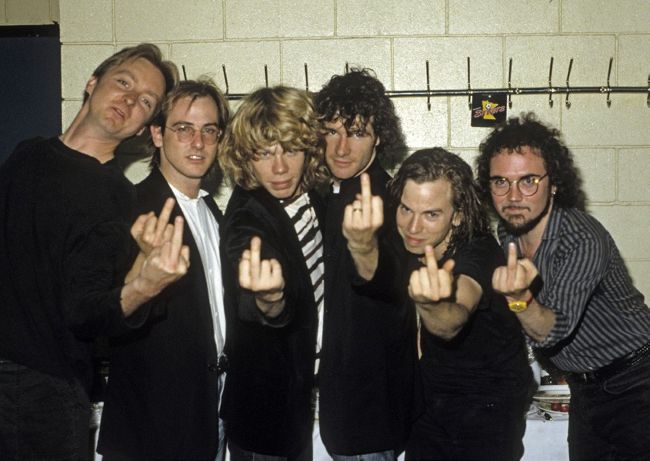
Born to run wild: author Warren Zanes (third left) gets ready to rock the First Avenue club, Minneapolis, with his Springsteenapproved band The Del Fuegos, December 1, 1985.
But I needed to know that I could go back and be nobody. If I really needed to.”
To get to that interview, I needed a point of entry. I’d met Springsteen’s manager Jon Landau several years earlier, while working on Thom Zimny’s documentary Elvis Presley: The Searcher. I was among those interviewed for the film, and then I interviewed Landau, a producer on the project, for the linernotes to a related Sony release. Thom Zimny helped me renew that connection.
Landau would be my first interview for Deliver Me From Nowhere. At the end of my first day with him, he said he’d mention my project to Bruce, though he wouldn’t ask Bruce to speak with me. That’s not how it works. He’d let Bruce know that if Bruce did speak with me, well, it might be a good conversation. A few days later, I was on Route 3, about 10 miles out the Lincoln Tunnel, when Jon Landau texted me to say Bruce was in.