CUTS AND BRUISES
THE ROLLING STONES were reeling. A guitarist down, beset by addiction and bereavement, out of time with label, management and the tax man. Somehow they came out of it with an album, Black And Blue, and a guitarist they've leant on for 50 years. How? "Everyone was winging it," discovers MARK BLAKE.
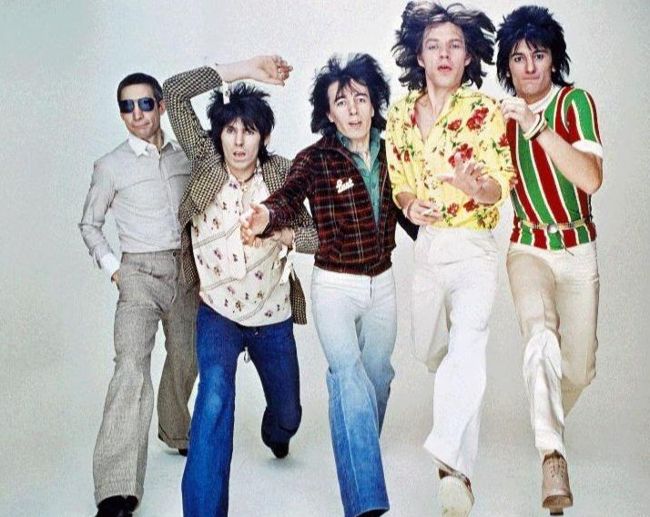
Best foot forward: The Rolling Stones (from left) Charlie Watts, Keith Richards, Bill Wyman, Mick Jagger, Ronnie Wood, June 1976.
Photograph by MICHAEL OCHS
IF WALLS COULD TALK, IMPRESARIO ROBERT Stigwood’s former residence, The Old Barn, could fill a book with stories. When ‘Stiggy’ wasn’t busy managing the Bee Gees and Eric Clapton, he threw lavish parties at his 16th-century mansion near Stanmore, north London. Bentleys lined the driveway, as actors, models and pop stars supped champagne inside the barn’s oak-beamed reception rooms and in its sweeping grounds.
In December 1974, the Faces’ guitarist Ronnie Wood arrived for another of Stigwood’s soirees and found himself sitting between The Rolling Stones’ two Micks. Suddenly, guitarist Mick Taylor leaned over to tell vocalist Mick Jagger he was leaving the group.
“I just laughed,” Wood recalled, “because that’s always been a cliché among musicians.”
Except Taylor was serious and, having dropped this bombshell, left the party.
“What am I gonna do?” Jagger asked Wood. “Will you join?” Wood told him he’d love to, but couldn’t possibly leave the Faces. “If I get desperate, can I call you?” Jagger implored. “Of course,” Wood replied, before reaching for another drink…
When news of Taylor’s departure became public, Melody Maker ran a list of potential replacements, including Wood, Jeff Beck, Ry Cooder, Steve Hillage (Steve Hillage?) and Mick Ronson. As Keith Richards bluntly remarked at the time, “The Rolling Stones ain’t gonna end just because a guitar player dies or leaves. It just ain’t so.”
Still, Wood ruled himself out. “I am a member of the Faces,” he said. “It was an enormous compliment to be considered. But, deep down, we all knew it could never happen.”
Seven months later, Ronnie Wood was touring America with Jagger and co, and in February 1976, he was anointed a full-time Rolling Stone.
A NEW WINDOW ON THIS PERIOD OF confusion opens this month with the release of a box set edition of Black And Blue, the LP the Stones somehow managed to complete amid the chaos. Remixed for 2025, its original album highlights – transatlantic Top 10 ballad Fool To Cry; the rueful Memory Motel – are joined by previously unreleased outtakes: the Miss You-ish I Love Ladies; an exuberant cover of Shirley & Company’s 1974 disco hit Shame, Shame, Shame; and live sets from Paris and London.
The box is especially revealing as regards the Stones’ search for a new guitarist, as cameos for Wood, Wayne Perkins and Harvey Mandel on the original album are joined by tracks featuring Jeff Beck (typically lyrical on the aforementioned I Love Ladies) and Robert A Johnson, a Memphis scene veteran recently employed by Isaac Hayes. Their contributions offer intriguing glimpses of multiple alternate futures for the Stones.
At the time, however, the vacant guitar berth was just one of the Stones’ several troubles. By the time recording on Black And Blue began in late ’74, the group’s ongoing tax exile and Richards’ drug busts had turned them into nomads, jet-setting between continents to stay one step ahead of the Inland Revenue and/or the law. “All those ’70s albums, Goats Head Soup, It’s Only Rock’N’Roll, Black And Blue were made on the run,” Richards told this writer.
Meanwhile, Mick Jagger was busy scrutinising the band’s finances. Black And Blue would be the band’s final studio set for Atlantic, the last under their punitive contract with former business manager Allen Klein, and Jagger had instructed the group’s money man, Prince Rupert Loewenstein, to find them a better deal – fast.