The software that taught a generation
Inspirational stories from computing’s long-distant past
Fun School was a class act that shaped how parents thought about computers, says David Crookes

Fun School gave a generation of kids an introduction to computers
Children can be remarkably persuasive, and parents can be easily swayed. So when, in the 1980s, a wave of home computers were released, many of them ended up being sold on the back of earnest promises from kids insisting that their chosen machine would help with their schoolwork.
In reality, computers were far more likely to be used for playing games, and perhaps the odd bit of tinkering with BASIC, but that didn’t prevent software developers trying to crack the home education market.
The early 1980s saw real growth in this software sector. In fact, the term “edutainment” had already been coined by this time: the Boston Phoenix, reporting on CES in 1983, cited edutainment as a “big area”.
Such software, it said, helped children learn how to type, spell, build their vocabulary and gain an understanding of geography, logical strategy and foreign languages. The apps also looked to disguise the fact children were learning: many of the titles were “colourful games with an educational overlay”, the article said.
But that’s not to say educational software was a hit in the home. Many such apps were created for use in the classroom. Then Fun School arrived, launched in 1985 by a company called Database Publications. Based around a set of learning-based games, it was released on the Acorn Electron, BBC Micro and Amstrad CPC 464, claiming to help young users with their maths, reading and general skills.
Database published some of the most iconic computer magazines of the 1980s, including The Micro User, while its managing editor was Derek Meakin, who also happened to be the company’s joint managing director.
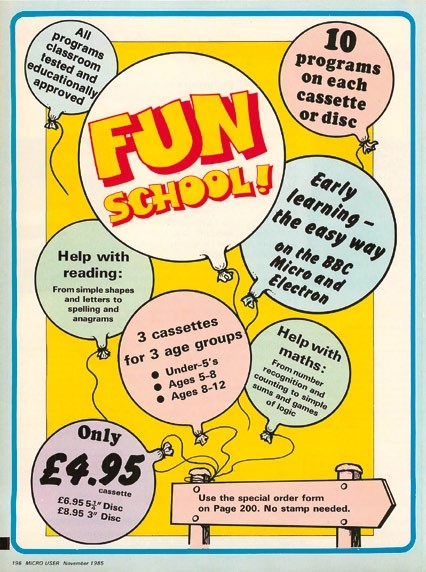
Where it all began: an advert in
The Micro User
in November 1985
The Micro User had already covered educational packages such as Dial Soft’s Child’s Play Pack and Chalksoft’s Wordskill for the BBC Micro. The educational game Granny’s Garden, released in 1983 for the BBC Micro, was also proving popular in schools.
Database knew its magazines could use in-house adverts to sell software it developed. Having achieved success with Mini Office, a suite that included a word processor, database, spreadsheet and graphics app, it believed it could dip its toes into the educational market with little risk, keeping the project as simple as possible.