THE PROG INTERVIEW
STEWART COPELAND
Every month we get inside the mind of one of the biggest names in music. This issue it’s Stewart Copeland. The Police’s long-limbed drummer has had a colourful life so far taking in time with Curved Air and Gizmodrome, as well as scoring movies by big-name directors Francis Ford Coppola and Oliver Stone. He discusses working with the British naturalist dubbed ‘The David Attenborough of sound’ on Wild Concerto; his role as an accidental Police archivist; and why he’s loving life as a septuagenarian.
Words: Philip Wilding
Stewart Copeland keeps moving. Professionally, creatively, behind his drum kit and, as it turns out, in interviews, too. Over an hour or so, as we chat via video-call, he does circuits of his expansive Sacred Grove home studio in Brentwood, Los Angeles, stopping only occasionally to flop down on the sofa. His flow of conversation only pauses when he thinks how to frame an answer or recall some minor historical detail. He’s a great advert for getting to 72.
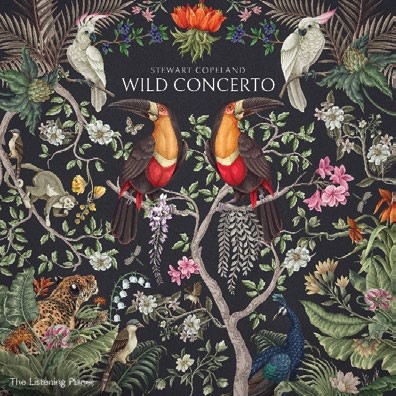
Copeland’s new classical album,
Wild Concerto.
PRESS/ARCHIE BROOKSBANK
We’re here to talk about his Wild Concerto classical album and a new Police picture book due later this year, charting the band’s very earliest days living hand-to-mouth as squatters in London, called The Police Lineup. Though both simply act as jumping-off points for conversational diversion: his oneman spoken-word shows, his time in Curved Air, his spirited leap from one of the biggest bands in the world – case in point, Synchronicity was selected by the US Library of Congress to be added to the National Recording Registry for being “culturally, historically, or aesthetically significant” – to successful composer of anything from opera to acclaimed film scores (he was nominated for a Golden Globe for his debut score for Francis Ford Coppola’s Rumble Fish). We also explore his friendship with both the Foo Fighters’ Taylor Hawkins and Rush’s Neil Peart, and why he and his brother still aren’t speaking.
Copeland grew up the son of a CIA operative, landing at various points in Virginia, Beirut, Cairo, and California; his childhood appears to have given him the sort of metaphorical sea legs that means he can adapt to almost anything and with some élan. Not least composing an album that fuses chirping Arctic terns and howling wolves with traditional instruments for the remarkable Wild Concerto.
In Curved Air I had the stacked boots, the long hair. In fact, I’ve got a whole bunch of shots of us playing at Cardiff Castle in 1976, Status Quo were headlining, and I’ve got these beautiful locks hanging down…”
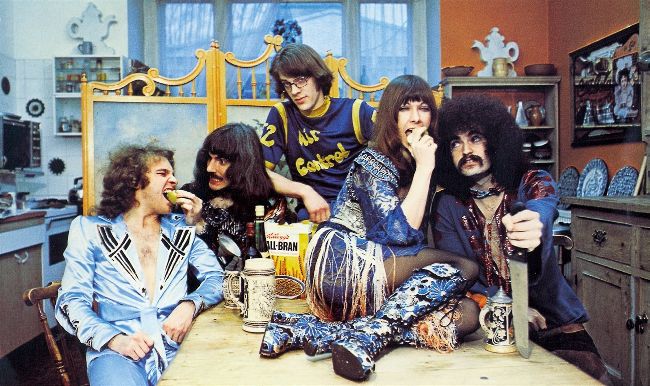
Copeland (centre), with Curved Air.
PRESS/CURVED AIR ARCHIVES
You’ve teamed up with British naturalist Martyn Stewart and his hugely extensive archive of field recordings for this latest album. Where do you start with a project of that magnitude?