What it’s like to be...
An ant
They might be small, but they pose big questions about the individual and the collective psyche
CAL FLYN
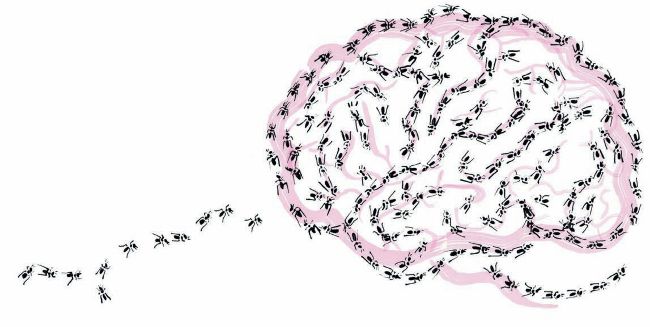
ILLUSTRATION BY KATE HAZELL
What would it mean to have a brain of many small moving parts? Ask an ant—or more specifically, ask an ant colony.
A single ant colony might comprise tens of thousands of individuals (and very occasionally, hundreds of thousands). That’s a lot of tiny minds at work—albeit rather simple minds. But many who study ants believe that ant colonies as a whole could reasonably be considered to exhibit a collective consciousness.
The extent to which social insects like ants might be considered to function as a “hive mind” has been a topic of scientific interest for a century or more. The noted American entomologist William Morton Wheeler argued in 1911 that the ant colony, “like the cell or the person,” “behaves as a unitary whole, maintaining its identity in space, resisting dissolution and, as a general rule, any fusion with other colonies.” Each colony has, he added, “its own peculiar idiosyncrasies of composition and behaviour” and is best considered an organism in and of itself.